Quick Answer
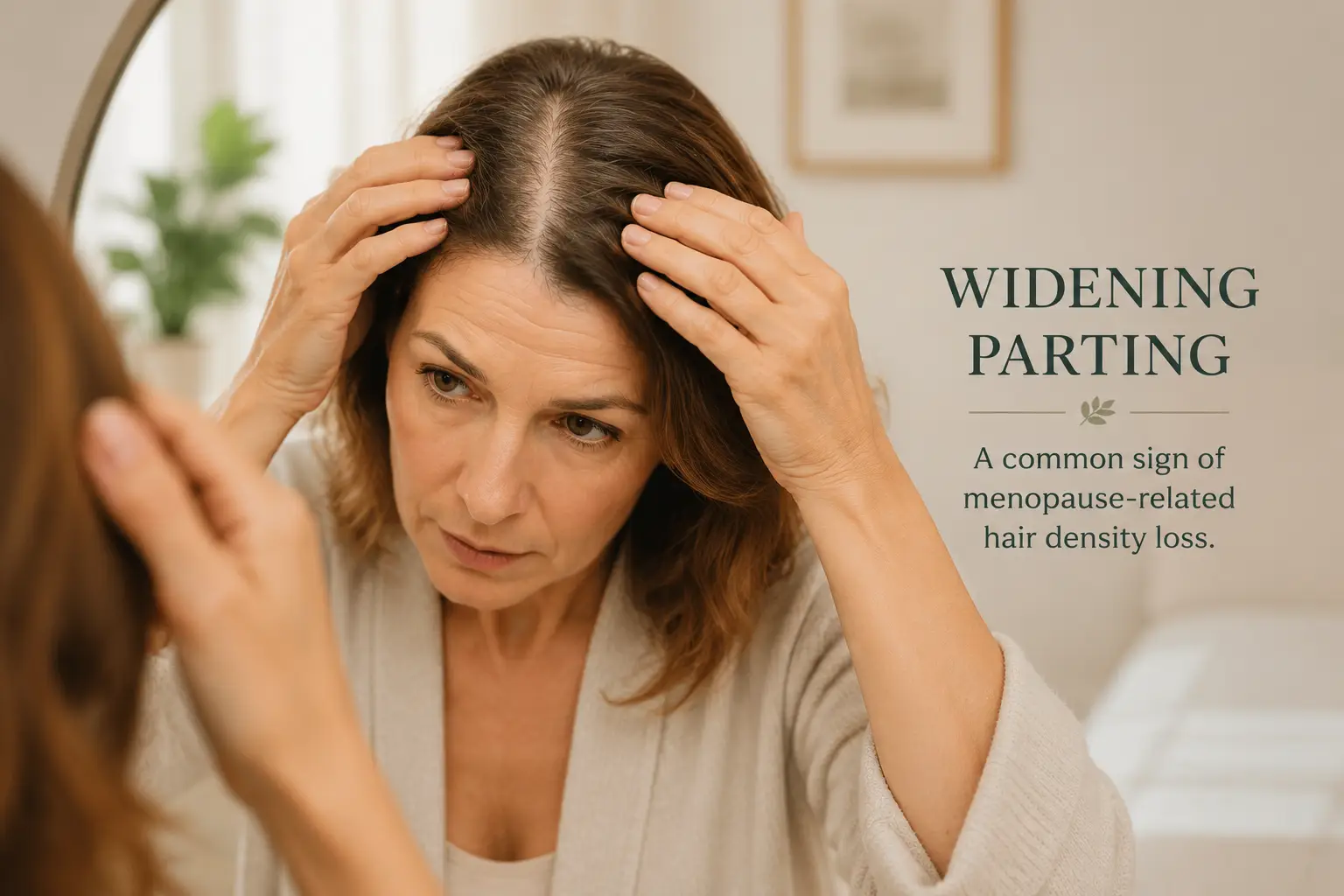
Hair thinning or hair loss can occur during perimenopause, but there is no single “menopause hair-loss” mechanism or pattern. Ageing, changing hormone levels, genetic susceptibility, female-pattern hair loss and temporary shedding can overlap. A gradually widening parting suggests female-pattern hair loss; sudden, heavy, patchy or painful loss needs medical assessment. Cosmetic care can improve manageability and reduce breakage, but it does not treat a medical cause of hair loss.
Key Takeaways
- The NHS lists hair thinning or hair loss among possible perimenopause and menopause symptoms, but not everyone experiences it.
- Research links midlife with changes in hair density, diameter and cycling, but the precise contribution of oestrogen is not fully established.
- Female-pattern hair loss usually causes gradual thinning over the crown and a wider central parting while the frontal hairline is retained.
- Iron deficiency, thyroid disease, illness, stress, weight loss, medication and other alopecias can resemble or compound midlife hair changes.
Perimenopause hair changes can be easy to miss at first. A ponytail may feel smaller, the parting may look wider in photographs, or previously manageable lengths may feel drier and more fragile. Those observations are real, but appearance alone cannot tell you whether the cause is female-pattern hair loss, a temporary shedding episode, hair-shaft damage, another health condition or a combination.
The useful first step is to separate three issues that are often bundled together: shedding (more hairs being released), density change (fewer or finer hairs covering the scalp) and shaft damage (breakage, roughness and reduced shine). They can happen at the same time, but they are not interchangeable.
What hormones can — and cannot — explain
Perimenopause is the transition before menopause, when periods and hormone levels change. The NHS says menopause and perimenopause usually affect women between 45 and 55, although they can happen earlier. Menopause is reached after 12 months without a period.
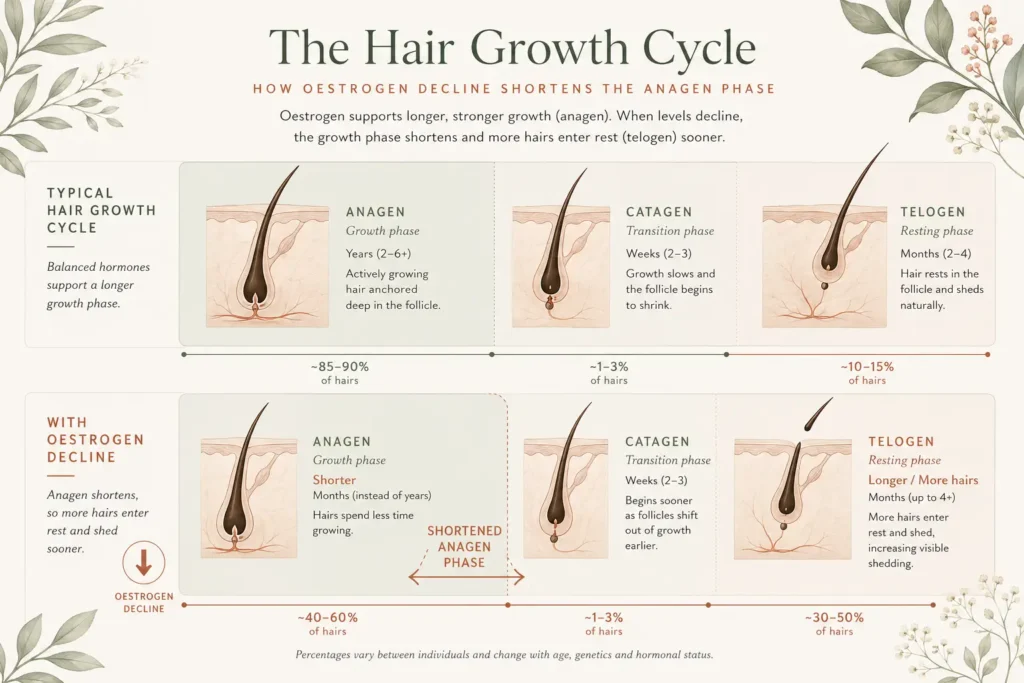
Scalp follicles cycle through anagen (growth), catagen (transition) and telogen (rest) before a hair is released. Oestrogen receptors are present in human hair follicles, and oestrogen is considered a modulator of hair biology. However, it is too definite to say that falling oestrogen simply “shortens anagen” in every perimenopausal woman. A clinical review of hair loss in midlife women reports measurable differences in growth rate, density, diameter and the proportion of hairs in anagen before and after menopause, while also stressing that oestrogen’s molecular pathways are not well characterised.
The same caution applies to androgens. Dihydrotestosterone (DHT) is central to male-pattern hair loss, but the role of androgens in female-pattern hair loss is less clear. A comprehensive review of female-pattern hair loss describes genetic, hormonal and environmental influences and notes the uncertainty around androgens. In other words, menopause may coincide with or reveal genetically susceptible pattern loss, but “oestrogen down, DHT up” is not a complete diagnosis.
Why hair can look finer
In female-pattern hair loss, affected follicles progressively produce hairs that are smaller in diameter and shorter. This miniaturisation reduces coverage even when there is no obvious bald patch. The typical signs are gradual thinning over the crown and frontal scalp, a widening central parting and relative preservation of the frontal hairline, as described by the British Association of Dermatologists.
Pattern loss is not the only reason a ponytail feels smaller. A temporary increase in shedding can reduce fullness, while weathering from bleach, straighteners, high heat, tight styles and friction can break the shaft. Age-related changes in shaft diameter and tolerance of chemical or heat damage also overlap with the menopausal transition. That is why a useful assessment looks at the pattern, speed, shedding, breakage, scalp condition, medicines and wider health rather than assuming one hormone explains everything.
The texture shift: dry, coarse or less manageable
Texture changes are common complaints in midlife, but they have several possible contributors. A review of the impact of menopause on skin and hair describes thinner, drier hair with ageing and lower scalp sebum later in menopause, while noting that hormone levels and sebum can fluctuate during perimenopause. Chemical processing, ultraviolet exposure, heat and friction can make roughness and breakage more visible too.
Greying is a separate biological process from female-pattern hair loss. Grey strands may behave differently in an individual’s routine, but colour alone does not prove that a strand is coarser. Judge what your own hair needs: more conditioning, less heat, gentler detangling or a cut that removes weathered ends.
Before attributing hair loss to perimenopause
The NHS hair-loss guidance lists illness, stress, weight loss and iron deficiency among causes of temporary loss. Depending on the presentation, a clinician may also consider thyroid disease, medicines, restrictive eating and alternative scalp disorders.
See a GP if you are worried, particularly if loss is sudden, rapid, patchy, accompanied by scalp redness, scale, soreness or scarring, or associated with new facial hair, acne or irregular periods beyond the changes expected in perimenopause. A clinician may consider a full blood count, ferritin, thyroid function and vitamin D depending on the history and examination; endocrine tests are more relevant when there are signs of androgen excess. Tests should be selected and interpreted clinically rather than treated as a universal shopping list.
Six practical habits for midlife hair

These steps can protect the hair fibre and make changes easier to monitor. They do not correct hormone levels or treat female-pattern hair loss.
- Wash for your scalp, not a rule. Use a frequency and cleanser that removes oil and styling residue without leaving the scalp persistently irritated. Washing does not cause hairs already in the shedding phase to become loose.
- Reduce avoidable breakage. Detangle gently, condition the lengths, limit repeated high heat and chemical processing, and avoid hairstyles that pull tightly for long periods.
- Protect exposed scalp and hair from strong sun. A hat or suitable scalp sunscreen helps protect visible skin along the parting. This is sun protection, not a treatment for follicle miniaturisation.
- Eat adequately and avoid unneeded supplements. Rapid weight loss and restrictive diets can trigger shedding. Iron or vitamin supplements should correct a confirmed or clinically suspected deficiency, not replace an assessment.
- Track the pattern consistently. Take monthly photographs of the centre part and temples in the same lighting and note heavy-shedding days, illness, medicine changes and menstrual changes. This record can help a GP or dermatologist.
- Ask about evidence-based treatment if pattern loss is diagnosed. NICE lists topical minoxidil as a management option for female-pattern hair loss. It is not suitable for everyone, can irritate the scalp, may cause an initial shed and generally needs continued use to maintain benefit, so discuss suitability with a pharmacist, GP or dermatologist.
Gradual thinning versus sudden shedding
Gradual thinning over the crown with a widening parting is more typical of female-pattern hair loss. Telogen effluvium is usually a more abrupt, diffuse increase in shedding after a trigger such as fever or illness, surgery, severe stress, rapid weight loss, childbirth or a medicine change. The trigger often precedes shedding by roughly two to four months because of the way follicles move through the hair cycle.
Temporary shedding and female-pattern hair loss can coexist, and visual inspection at home cannot always separate them. If the change sounds more like an acute shedding episode, read the guide to telogen effluvium, then speak to a clinician if shedding is severe, prolonged or unexplained.
Your scalp may need different care too
Some people notice dryness, itch or changing oiliness around perimenopause, but persistent symptoms deserve attention. Dandruff, eczema, psoriasis, contact dermatitis and inflammatory or scarring alopecias are not simply “hormonal imbalance.” Stop products that clearly sting or inflame the scalp and seek assessment for ongoing redness, scale, pustules, pain, crusting or loss of follicle openings.
If oiliness is the main issue, this guide to a greasy scalp after washing explains common routine factors. For more context on density and scalp oil, read menopause, scalp oil and hair density.
Cut, colour and styling when texture changes
A blunt or lightly layered cut can make fine ends look fuller, but the best shape depends on curl pattern, density and styling habits. Colour can reduce contrast between hair and scalp, while fibres, parting changes and root powders can provide temporary camouflage. These are aesthetic options, not treatments.
Bleach, straightening and repeated high heat weaken the shaft. If your hair now breaks more easily, reduce temperature and passes, use conditioner and a heat-protectant product according to its directions, and space out chemical services. Breakage improves only as protected hair grows and damaged length is trimmed; it is not the same as new growth from the follicle.
What to discuss with your GP
Describe when the change started, whether it is shedding, thinning or breakage, and whether it is diffuse or patchy. Mention heavy periods, recent illness, weight change, dietary restriction, stress, pregnancy, new medicines, scalp symptoms, family history and signs of androgen excess. Bring consistent photographs if you have them.
Ask what diagnosis best fits and whether examination, blood tests or dermatology referral are appropriate. HRT may be discussed for menopausal symptoms according to your overall benefits and risks, but evidence for HRT as a hair-loss treatment is limited. The midlife review cited above states that HRT has not been adequately studied for female-pattern hair loss and should be considered only when indicated for other reasons; NICE menopause guidance supports individualised decisions about HRT for menopause care, not its use as a cosmetic hair treatment.
What these changes do not tell you
They do not mean you cared for your hair badly, and they do not identify a diagnosis by themselves. Shampoo cannot reverse follicle miniaturisation, while a wider parting is not proof that DHT is the cause. Female-pattern hair loss often follows a different distribution from male-pattern loss, but women can also develop other diffuse, patchy or scarring forms that need different management.
Hair loss can have a substantial psychological impact. NICE and the British Association of Dermatologists both recognise effects on self-esteem and wellbeing. It is reasonable to ask for help if hair changes are distressing, even when they are medically benign.
A disclosed cosmetic option
Disclosure: Nunu Moor Scalp & Hair Tonic is our own commercial cosmetic product in development. It is intended for everyday scalp and hair care, heat protection and light styling—not to treat perimenopause, female-pattern hair loss or another medical cause of shedding.
If that cosmetic scope suits your needs, you can join the Nunu Moor launch waitlist for early access and founder pricing. For unexplained or concerning hair loss, seek medical advice rather than relying on a cosmetic product.
FAQ
At what age can perimenopause hair changes start?
Perimenopause and menopause usually affect women between 45 and 55, according to the NHS, but can begin earlier. Hair changes have no reliable timetable and may reflect ageing or another diagnosis as well as the menopause transition.
Why is my hair getting finer rather than just falling out?
Female-pattern hair loss miniaturises susceptible follicles, producing progressively finer, shorter hairs. Age-related diameter changes and shaft breakage can also make hair feel finer. An examination is needed to distinguish them.
Will menopausal hair thinning grow back?
That depends on the cause. Telogen effluvium often recovers after its trigger resolves, whereas female-pattern hair loss is progressive and is managed rather than cured. Treating a confirmed deficiency or health condition may help loss caused by that condition. No cosmetic product can promise regrowth.
Is menopause the only cause of thinning in midlife?
No. Pattern hair loss, iron deficiency, thyroid disease, acute illness, stress, weight loss, medicines, traction and inflammatory or autoimmune alopecias are among the alternatives a clinician may consider.
Can scalp care help?
Appropriate cleansing, conditioning and gentle styling can improve comfort, appearance and breakage. They do not alter systemic hormones or substitute for diagnosis and treatment of hair loss.
Should I take iron, biotin or vitamin D?
Not automatically. Supplements are most appropriate when a deficiency or clinical need has been identified. Ask a clinician or pharmacist before starting iron, biotin, vitamin D or another supplement for hair loss.
Related reading
- Menopause, scalp oil and hair density
- Telogen effluvium: why you’re shedding and when it stops
- A one-minute cosmetic scalp-care ritual
Sources and further reading
- NHS: Menopause and perimenopause
- NHS: Symptoms of menopause and perimenopause
- NHS: Hair loss
- NICE NG23: Menopause — identification and management
- British Association of Dermatologists: Female-pattern hair loss
- Mirmirani P. Managing hair loss in midlife women
- Female pattern hair loss: a comprehensive review
- Skin, hair and beyond: the impact of menopause
This article provides general information and is not a diagnosis or a substitute for individual medical advice.