Quick Answer
Hair thinning can become more noticeable around perimenopause and menopause, but a newly oily scalp and reduced hair density are not automatically one hormonal problem. Menopause may contribute to changes in the hair cycle and fibre diameter, while female-pattern hair loss, temporary shedding, ageing, genetics, illness, nutrition, medication and scalp conditions can overlap. Scalp oiliness may also reflect sebum production, product build-up or a skin condition. Cosmetic scalp care can help with comfort and manageability, but it cannot correct hormones or regrow miniaturised follicles.
Key Takeaways
- Menopause can coincide with hair changes, but timing alone does not prove that falling oestrogen is the only cause.
- An oily scalp and dry lengths can occur together, but oiliness does not prove androgen excess and is not a reliable measure of hair-loss risk.
- Hair density means the number of hairs in a given scalp area; fibre diameter is a separate feature that also affects how full hair looks.
- Sudden, patchy, painful or inflamed hair loss needs medical assessment rather than a cosmetic solution.
- Scalp products may cleanse, condition or improve cosmetic feel, but they should not be presented as treatments for menopause-related hair loss.
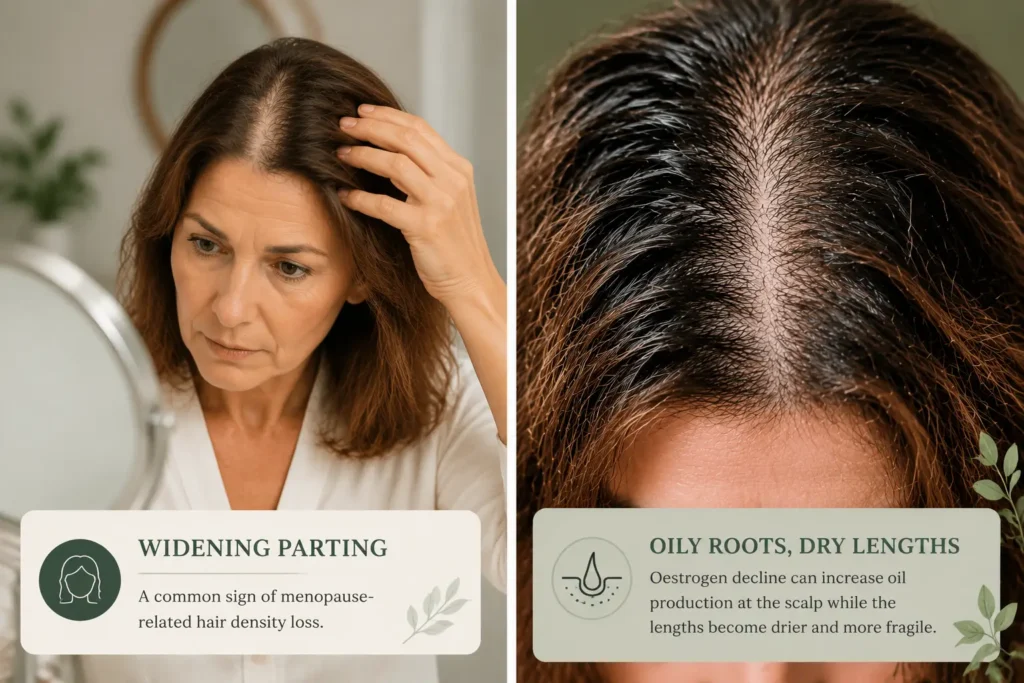
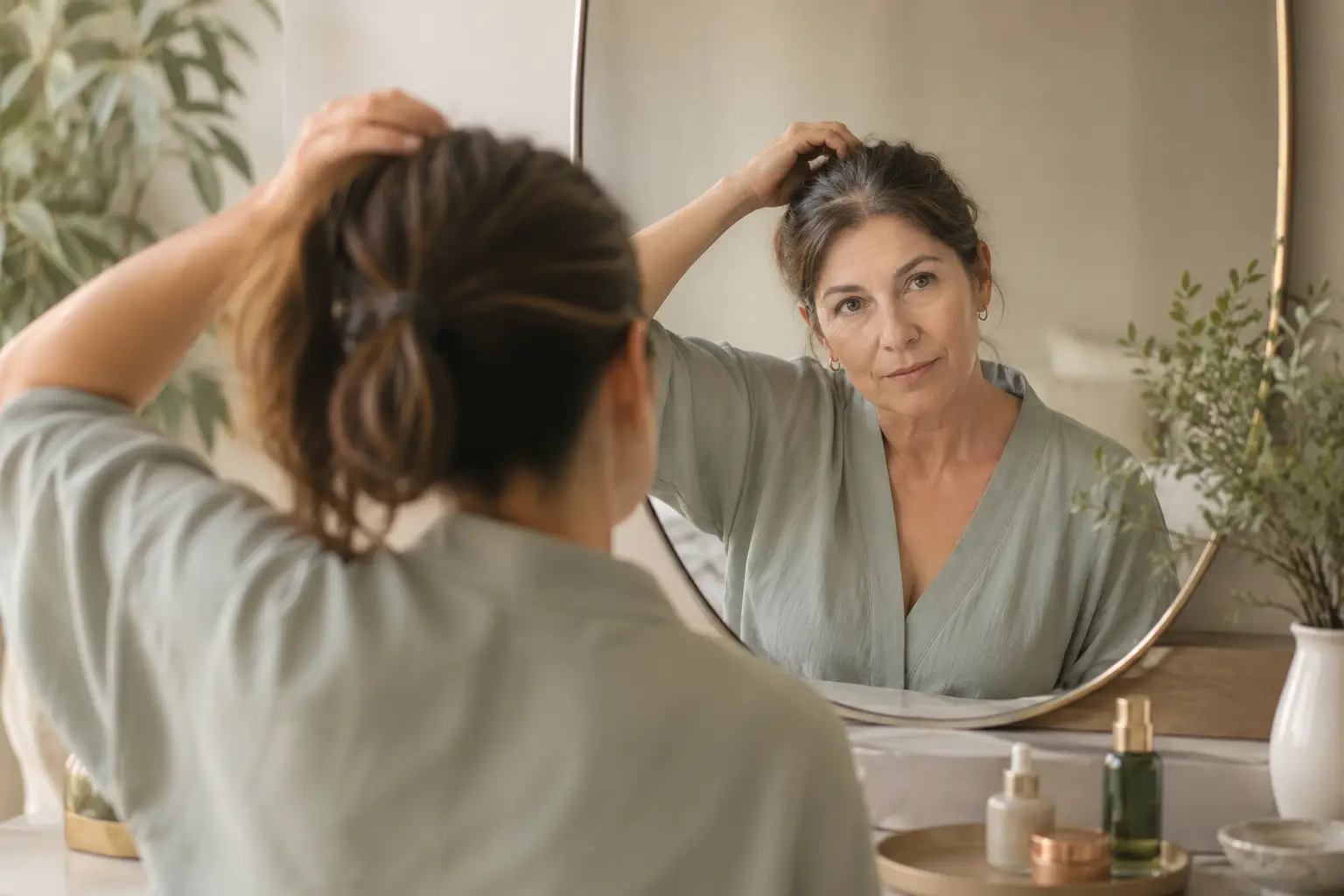
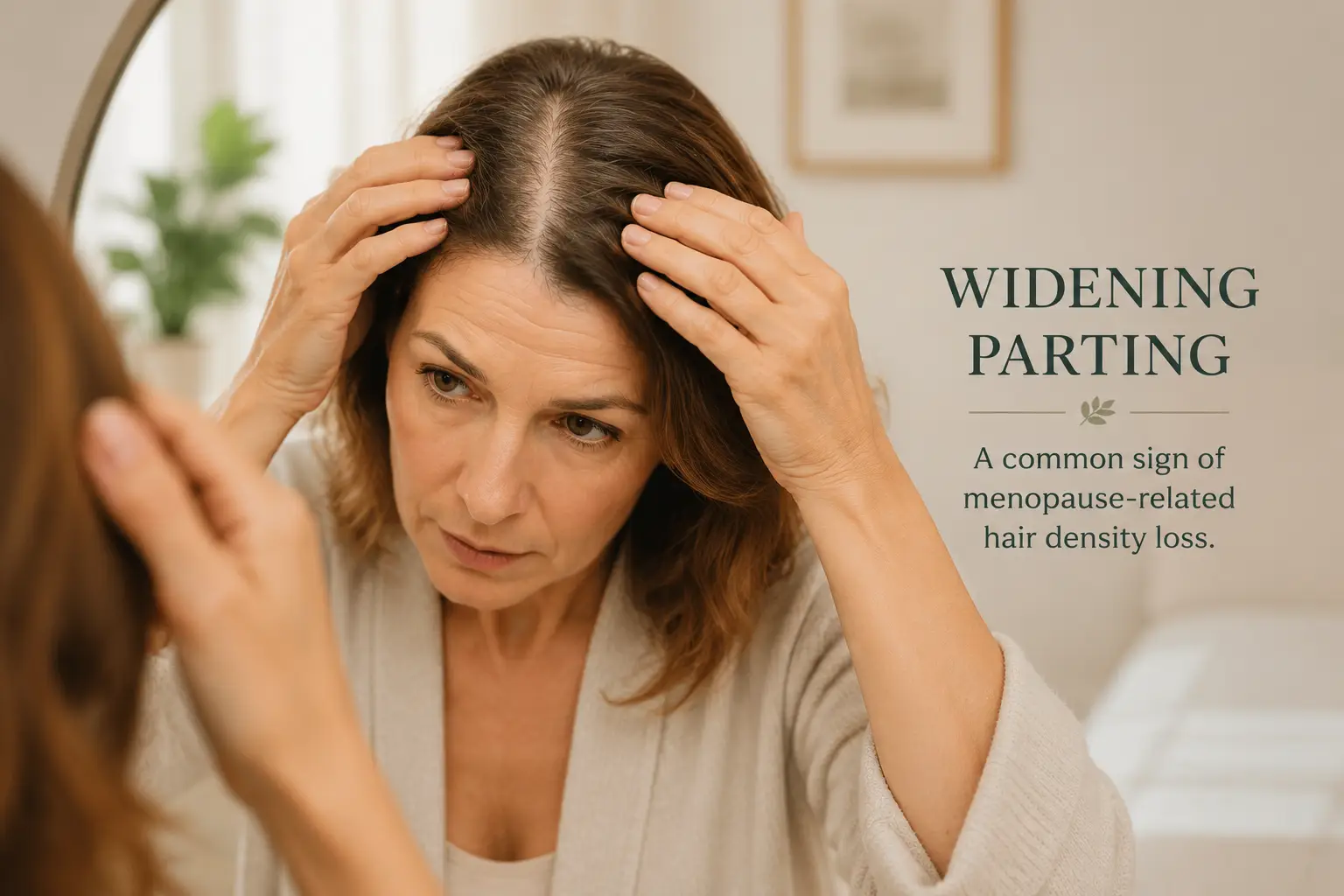
Menopause hair thinning rarely fits one neat explanation. You may notice a wider part, a ponytail with less girth, more hair in the brush, or a change in texture. At the same time, the roots may feel greasy sooner while the lengths feel drier and more fragile.
Those changes can happen together, but they should not be collapsed into a single diagnosis. Hormonal change is one part of the picture. Ageing, inherited follicle sensitivity, a temporary shedding episode, nutritional deficiency, thyroid disease, medication, styling damage and inflammatory scalp conditions can all contribute. Separating scalp oil, fibre condition, shedding and true loss of density leads to more useful care.
What Hormonal Change Can—and Cannot—Explain
Hair follicles respond to hormonal signals, and the menopausal transition is associated with changes in hair cycling, diameter, texture and density. A 2025 clinical review of menopause and hair loss discusses these changes while also describing several distinct hair-loss conditions that may occur in this age group.
It is reasonable to say that changing oestrogen and androgen signalling may contribute to hair changes in susceptible people. It is not reasonable to say that falling oestrogen always makes scalp oil glands overactive, that oiliness and thinning must share one cause, or that every woman’s androgen level effectively rises. Hormone levels, follicle sensitivity and clinical patterns vary, and many women with thinning hair have no sign of androgen excess.
HRT should not be treated as a hair-regrowth shortcut. A peer-reviewed review in Climacteric states that HRT is not indicated for skin and hair symptoms alone. Decisions about HRT should be based on menopause symptoms, medical history, preferences and the overall balance of benefits and risks, with a qualified clinician.
Why Roots Can Feel Oily While Lengths Feel Dry
Sebaceous glands make sebum, which coats the scalp and hair. Androgens influence sebaceous-gland activity, but a greasy scalp is not proof that menopause has caused an androgen problem. How quickly roots look oily also depends on individual skin biology, wash frequency, sweat, styling products, fine hair that shows oil readily, and conditions such as seborrhoeic dermatitis.
The lengths can still feel dry because scalp oil does not distribute evenly along every fibre. Longer, curly, colour-treated, heat-damaged or weathered hair is particularly prone to roughness and breakage. That is a difference between scalp skin and the older hair fibre—not evidence that one hormone has simultaneously “switched on” oil at the root and “switched off” moisture at the ends.
There is also no good basis for the familiar claim that shampooing makes sebaceous glands “rebound” and produce extra oil to compensate. Wash often enough to keep the scalp comfortable, using a cleanser that does not leave persistent irritation. If oiliness comes with marked itch, redness, soreness, heavy scale or crusting, ask a pharmacist, GP or dermatologist about a possible scalp condition.
What Hair Density Actually Means
Hair density is the number of hairs in a defined area of scalp. Hair-shaft diameter, sometimes called calibre, is a separate measurement. Both affect visual fullness: fewer hairs reduce coverage, while finer fibres allow more scalp to show even if the number of follicles has not changed dramatically.
In female-pattern hair loss, susceptible follicles can gradually produce finer, shorter hairs through miniaturisation. The British Association of Dermatologists’ guidance on female-pattern hair loss describes progressive thinning that commonly makes the central part more visible while the frontal hairline is often retained.
That pattern is different from breakage, where fibres snap but follicles remain active, and from telogen effluvium, where an increased proportion of hairs shed after a trigger. The conditions can overlap, which is why appearance alone does not always provide a firm diagnosis.
Oiliness and Thinning Need Separate Questions
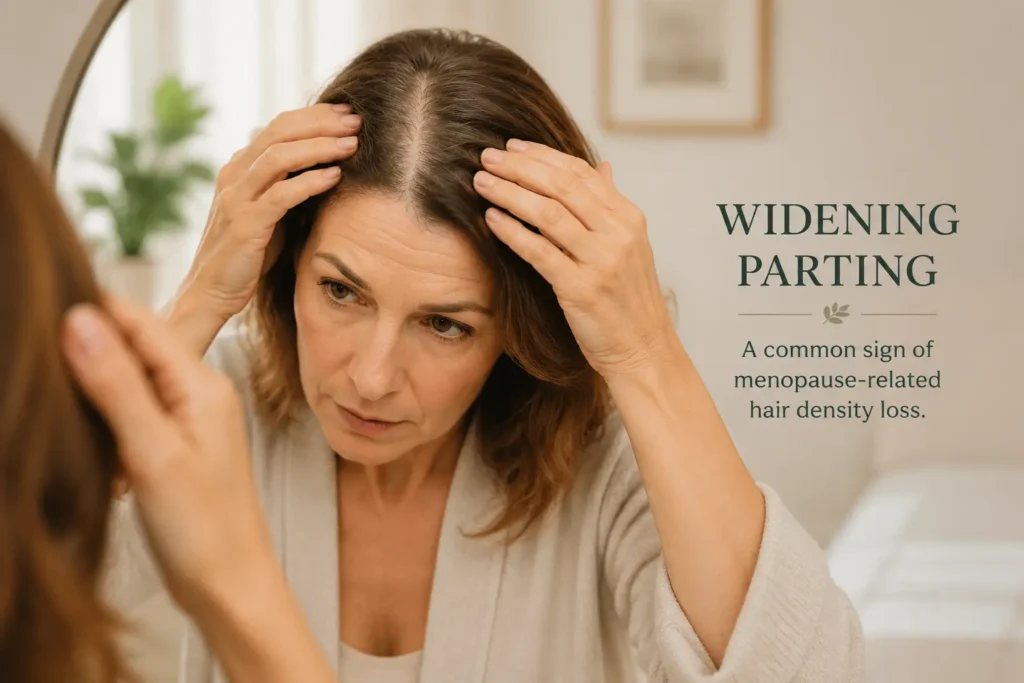
If your roots are greasy and your part looks wider, ask two sets of questions. For the scalp: Is there itch, scale, redness, soreness or product build-up? For the hair: Is the change gradual or sudden, diffuse or patchy, and are whole hairs shedding or are fibres breaking?
A balanced routine can keep the scalp clean and the fibre conditioned, but “supporting the scalp environment” should not be confused with treating a follicle disorder. Oils, tonics and massage have not been shown to correct menopausal hormone changes or reliably increase hair density. A cosmetic product may still be useful for feel, styling and reduced friction when its role is described honestly.
First, Rule Out Other Causes
See a GP if hair loss is worrying you, and seek assessment promptly when it is sudden, patchy, rapidly progressive, painful or accompanied by scalp inflammation, eyebrow loss or other new symptoms. The NHS hair-loss guidance explains that hair loss may be temporary or permanent and advises getting a medical opinion before approaching a commercial hair clinic.
A clinician may consider recent illness, surgery, weight change, restrictive eating, stress, medicines, family history, menstrual changes and signs of a scalp disorder. Blood tests are not a universal panel that everyone needs. Depending on the history and examination, testing may include a full blood count, ferritin or iron status, thyroid function or other investigations. Take supplements only when a clinician has identified a need or advised them; more is not automatically better.
Five Practical Ways to Care for Thinning Hair and an Oily Scalp
- Cleanse for comfort. Wash when the scalp feels oily, sweaty or uncomfortable. Choose a shampoo that removes oil and product without causing persistent burning, itching or tightness. There is no need to “train” the scalp by tolerating build-up.
- Condition the fibre separately. Apply conditioner mainly to mid-lengths and ends if the roots become flat easily. This addresses dryness and friction without assuming the scalp itself needs extra oil.
- Reduce avoidable breakage. Use less repeated high heat, loosen tight styles, detangle gently and avoid aggressive brushing. These steps can preserve fibre length and improve the appearance of fullness, although they do not change follicle count.
- Track the pattern. Take a monthly photograph of the part and temples in the same light and from the same angle. Note illness, medication changes and shedding. The record can help a clinician distinguish gradual thinning from a temporary shed.
- Match treatment to diagnosis. If female-pattern hair loss is diagnosed, ask whether a condition-specific treatment is appropriate. The NHS notes that minoxidil may be used for female-pattern baldness, but it does not work for everyone and benefits are maintained only while it is used. Discuss suitability, adverse effects, pregnancy precautions and expectations with a healthcare professional.
The Nunu Moor Approach
Disclosure: Nunu Moor Scalp & Hair Tonic is our own product in development. It is a cosmetic product designed for everyday scalp care, heat protection and light styling. It is not a hormone treatment, does not treat menopause-related hair loss and should not be expected to regrow follicles or increase biological hair density.

If a streamlined cosmetic routine appeals to you, join the Nunu Moor launch waitlist for early access and founder pricing. Continue to seek medical advice for unexplained thinning, heavy shedding or scalp symptoms.
Menopause can be part of the story without explaining every change. Treat scalp oiliness as a scalp-care question, dryness as a fibre-care question and loss of density as a reason to identify the pattern and cause. That approach is less dramatic than a single hormonal explanation, but it is more accurate and more likely to lead to appropriate care.
How Long Does Menopause Hair Thinning Last?
There is no standard menopause-hair timeline. A temporary telogen effluvium episode may settle after its trigger resolves, while untreated female-pattern hair loss is usually progressive. Breakage can improve as hair-care practices change, and a deficiency-related shed may improve when the underlying problem is corrected. Because these processes behave differently, a promise that thinning will stop a set number of years after the final period is not evidence-based.
Can Menopause Hair Thinning Be Reversed?
It depends on the diagnosis. Hair may recover after some temporary triggers are corrected, although regrowth takes time. Female-pattern hair loss can often be managed, but no treatment works for everyone and cosmetics cannot reverse follicle miniaturisation. Scarring alopecia requires prompt medical care because destroyed follicles cannot regrow.
Ask a clinician about evidence-based options rather than assuming HRT, supplements or a scalp oil will restore density. HRT may be appropriate for menopausal symptoms overall, but it is not a stand-alone hair-loss treatment. Do not start, stop or change prescribed hormones or hair-loss medication on the basis of this article.
Menopause Hair Thinning vs Telogen Effluvium
Female-pattern hair loss commonly appears as gradual thinning over the top of the scalp and a widening central part. Telogen effluvium is usually a more noticeable, diffuse increase in shedding that follows a physical or emotional trigger after a delay. A clinician may identify both at once, and other forms of hair loss can look similar without a scalp examination.
Bring a timeline to your appointment: when shedding began, any illness, surgery, major stress, weight or dietary change, and changes to medicines or hormones. Photographs and an estimate of whether loss is worsening can be more useful than trying to count every shed hair.
What to Ask Your GP or Dermatologist
- Does this look like female-pattern hair loss, telogen effluvium, breakage or a scalp condition?
- Do my symptoms and examination suggest that any blood tests are appropriate?
- Could a medicine, recent illness, diet change or scalp disorder be contributing?
- Would a hair-specific treatment or dermatology referral be appropriate?
- Which signs should prompt an earlier review?
Mention new facial hair, acne, irregular bleeding outside the expected transition, scalp pain, scale, redness, smooth patches, eyebrow loss or recession at the frontal hairline. These details can change the assessment and should not be dismissed as “just menopause.”
A Realistic 12-Week Observation Routine
Twelve weeks can establish a useful baseline and show whether scalp comfort or breakage is improving, but it is not a universal deadline for regrowth. Hair cycles are slow, and the right review period depends on the diagnosis and any treatment chosen.
Weeks 1 to 2—record the baseline. Photograph the central part and temples in consistent light. Note shedding, scalp symptoms, recent health events and current medicines. Arrange a medical assessment if loss is rapid, unusual or distressing.
Weeks 3 to 6—simplify care. Use a comfortable cleansing schedule, condition the lengths, reduce tight styles and high heat, and avoid introducing several new oils or supplements at once. A simpler routine makes irritation and build-up easier to identify.
Weeks 7 to 12—review, do not over-interpret. Repeat photographs under the same conditions and review any clinician advice or test results. Scalp comfort and fibre feel may change before density. If shedding accelerates or new warning signs appear, seek review rather than buying another cosmetic.
What Menopause Hair Thinning Is Not
It is not proof that you neglected your hair or chose the wrong shampoo. It is not always female-pattern hair loss, and it is not always caused by low oestrogen. It is also not something a scalp oil can diagnose or treat.
Hair changes can still have a real emotional effect. Cosmetic choices such as a blunter cut, a different part, fibres or colour adjustments may improve the appearance of fullness while you investigate the cause. Using those options does not make the concern trivial, and asking for a second medical opinion is reasonable if significant or unusual loss has not been assessed.
FAQ
Why is my scalp oily but my hair dry in menopause?
Scalp sebum, product build-up and individual skin biology can make roots look oily, while weathering, colour, heat and poor sebum distribution leave older lengths dry. The combination can occur during menopause, but it does not by itself prove a hormonal cause.
Does washing more make an oily scalp worse?
Washing does not make sebaceous glands “rebound” by producing compensatory oil. Cleanse often enough for comfort with a suitable shampoo. Persistent oiliness with itch, redness or scale may need advice from a pharmacist or clinician.
What is hair density?
Hair density is the number of hairs in a defined area of scalp. Hair-shaft diameter is separate, although both influence how full the hair appears.
Can a scalp oil restore density?
No scalp oil has been shown to correct menopausal hormones or reliably restore lost follicle density. Oils may condition hair or reduce friction, but they can also weigh down fine hair or aggravate build-up for some people.
Is an oily scalp in menopause hormonal?
It may be influenced by hormonal biology, but oiliness alone cannot identify the cause or show that androgen levels are high. Products, sweating, wash habits and scalp conditions can also contribute.
Should everyone with menopausal hair thinning request the same blood panel?
No. A clinician should choose tests based on the history, examination and suspected cause. Full blood count, ferritin or iron status and thyroid testing may be considered in some cases, but universal testing and self-prescribed supplements are not appropriate.
Authoritative Sources and Further Reading
- NHS: Hair loss
- British Association of Dermatologists: Female-pattern hair loss
- PubMed: Menopause and hair loss review
- PubMed: Menopause, skin and hair review
This article provides general information, not individual medical advice. A cosmetic product cannot diagnose or treat hair loss. Speak with a qualified healthcare professional before starting, stopping or changing HRT, supplements or hair-loss treatment.