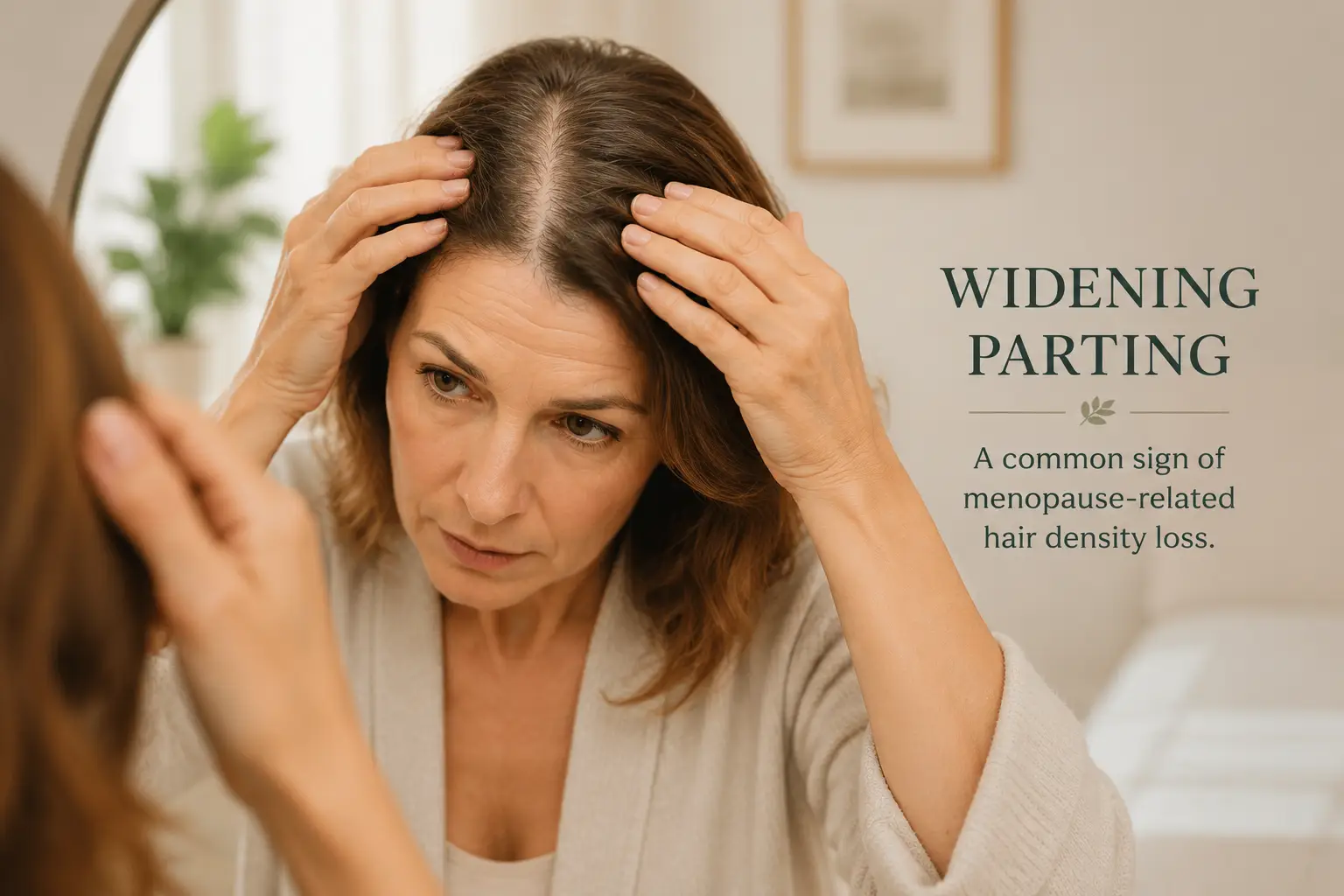

Quick Answer: Female pattern hair loss is gradual thinning across the crown and parting, driven by genetics and hormones, which often becomes more noticeable after menopause. The hairline usually stays intact while the parting widens. It’s common, progressive and manageable — and early diagnosis gives you the most options to preserve density.
Key Takeaways:
- It shows as a widening parting and thinning crown, usually with the hairline preserved.
- It’s gradual thinning over years, not sudden shedding.
- Genetics and hormones drive it; menopause often makes it more visible.
- Minoxidil is the only UK-licensed treatment specifically for it.
- The earlier you act, the more density you can preserve.
Female pattern hair loss is the most common form of hair loss in women, and yet many women live with it for years without anyone naming it. You notice the parting looks wider in photos, the crown catches the light, the ponytail is thinner — but there’s no bald patch and no dramatic shedding, so it’s easy to dismiss. Here are six signs that help you recognise it, and what’s genuinely worth doing next.
1. The Parting Widens First
The classic early sign is a parting that gradually looks broader, especially at the top of the head. Many women spot it in photographs or under overhead lighting before they notice it in the mirror.
Clinicians sometimes describe the pattern as a “Christmas tree” shape, broader towards the front of the parting.
2. The Hairline Usually Stays Intact
Unlike male pattern baldness, female pattern hair loss rarely causes a receding hairline. The front edge tends to stay put while density thins behind it, across the crown and top.
That’s one reason it can go unrecognised for so long — the frame of the face looks unchanged.
3. It’s Gradual Thinning, Not Sudden Shedding
This is the key distinction. Sudden handfuls in the shower usually point to temporary shedding, which I cover in telogen effluvium 101. Pattern thinning is slower: individual follicles gradually miniaturise, producing finer, shorter hairs over successive cycles.
It’s possible to have both at once, which is another reason a proper assessment helps.
4. Female Pattern Hair Loss Often Shows More After Menopause
Genetics loads the gun; hormones influence how visible it becomes. As oestrogen declines, the relative influence of androgens rises, and sensitive follicles can miniaturise faster. I explain that mechanism in why your hair texture changes at 45.
It can begin at any age after puberty, but many women first notice it in their 40s and 50s.
5. The Strands Themselves Change
Look closely and you’ll often see a mix of normal hairs and noticeably finer ones in the same area. That variation in calibre is a hallmark of miniaturisation, and it’s something a dermatologist or trichologist can assess with a magnified scalp examination.
6. Other Causes Can Look Identical
Low ferritin, thyroid problems and vitamin D deficiency can all produce diffuse thinning that mimics pattern loss. Ask your GP for a blood panel before assuming — see ferritin and hair loss and thyroid hair loss.
Correcting a deficiency won’t reverse genetic miniaturisation, but it removes anything making it worse.

What the Treatment Picture Looks Like
Minoxidil is the only UK-licensed treatment specifically for female pattern hair loss. It needs consistent, ongoing use, often causes an initial shed in the first weeks, and takes months to show results. The NHS hair loss guidance covers the basics, and the British Association of Dermatologists publishes detailed patient information.
Specialists may discuss other prescription options in some cases. Those are individual medical decisions, made with a dermatologist or GP, not something to self-source online.
Where Scalp Care Fits
Scalp care won’t reverse genetic thinning, and I won’t pretend otherwise. What it does is give the follicles you have the healthiest possible environment: calm, well-circulated, not stripped or congested. It pairs sensibly with medical treatment rather than replacing it.
Practical styling helps day to day too — a well-judged cut and dimensional colour can dramatically reduce how visible a widening parting looks, as I set out in thin hair volume.
The Honest Outlook
Female pattern hair loss is progressive, but progressive doesn’t mean hopeless. Recognised early and managed consistently, many women stabilise their density for years. The goal is preservation, and that starts with getting it named.
Nunu Moor is our commercial botanical scalp-and-hair care brand. Join the Nunu Moor launch waitlist for launch updates, early access and founder pricing. The tonic is a cosmetic product, not a treatment for hair loss.
This is general information, not a diagnosis. Please see your GP or a dermatologist for assessment.
FAQ:
- What does female pattern hair loss look like? A gradually widening parting and thinning across the crown and top of the head, usually with the front hairline preserved.
- What causes female pattern hair loss? A combination of genetic predisposition and hormonal influence, with sensitive follicles gradually miniaturising. It often becomes more visible after menopause.
- Is female pattern hair loss reversible? It’s progressive and not usually fully reversible, but it can often be slowed and stabilised, especially when treated early.
- What is the treatment for female pattern hair loss in the UK? Minoxidil is the only UK-licensed treatment specifically for it. Specialists may discuss other options individually.
- How is it different from telogen effluvium? Telogen effluvium is sudden, temporary shedding after a trigger. Pattern hair loss is slow, progressive thinning of the strands themselves.