QUICK ANSWER
A one-minute scalp ritual means applying a small amount of a lightweight, leave-in cosmetic scalp product along a few parting lines, then massaging gently with your fingertips. It can be a convenient way to care for scalp comfort without adding a rinse step or coating the lengths. It is not a treatment for hair loss, and there is no good evidence that a 60-second massage regrows hair.
KEY TAKEAWAYS
- Scalp care is often abandoned when it is slow or greasy, so a fast, lightweight leave-in approach may be easier to maintain.
- Apply sparingly along parting lines; massage gently for comfort, not as a regrowth treatment.
- Choose non-greasy, water-light formulas over heavy oils that need re-washing.
- Use the product only as often as its directions allow and your scalp tolerates; a simple routine is easier to maintain.

The real reason a scalp ritual may not stick is not a lack of care. It is often the practical burden: extra washing, a long application or a finish that disrupts the style you already created. When a treatment makes the roots look greasy or takes too much time, it is easy to abandon.
So this is the alternative: a scalp ritual designed to take about sixty seconds and minimise residue. Not a spa ritual. A weekday one.
Why “quick and clean” is the whole game
Two practical barriers can derail a scalp routine. The first is time—the “I know I should, but who has twenty minutes?” trap. The second is residue: a product that leaves the roots oily can undo the style you just created.
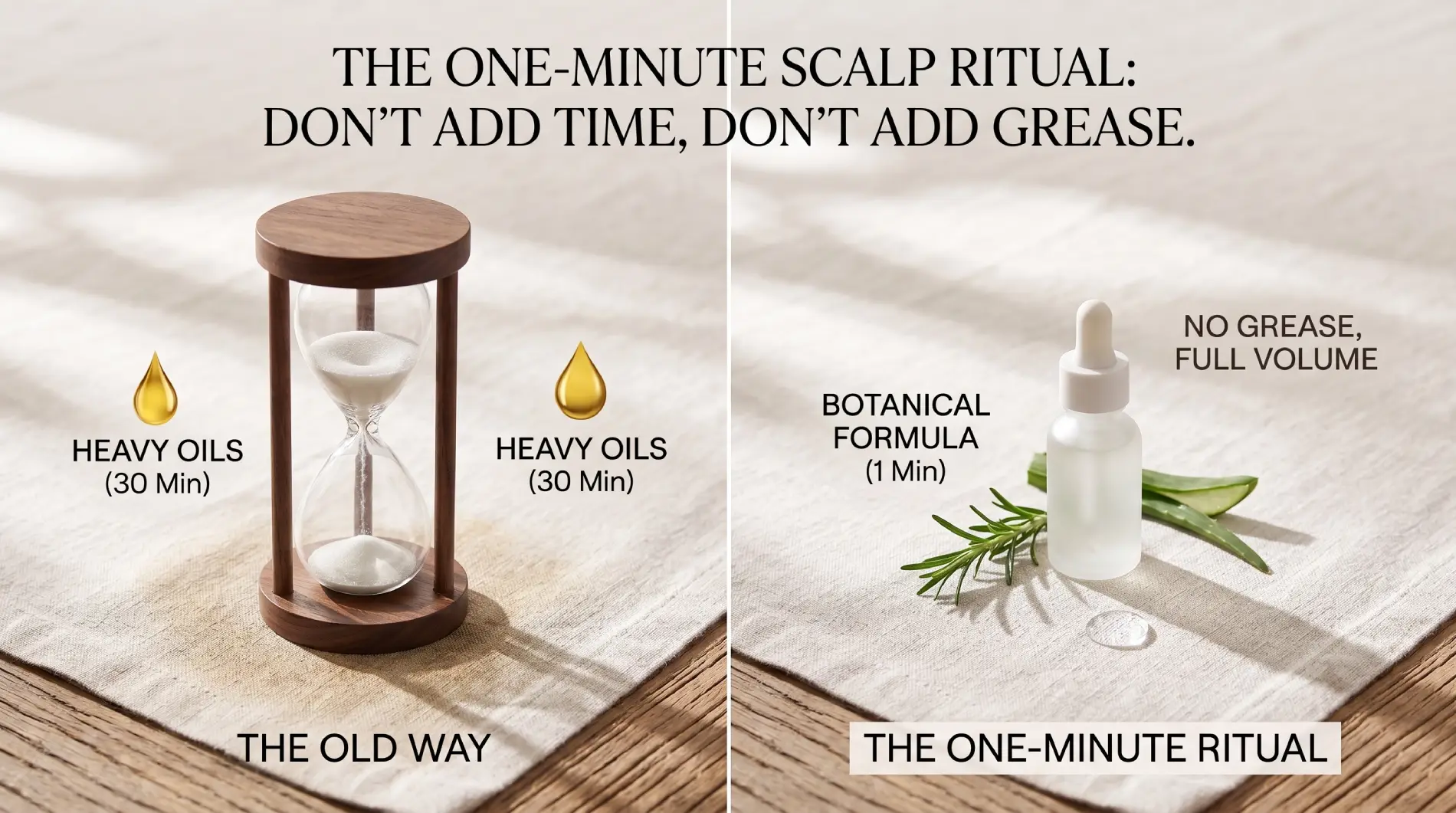
A convenient leave-in ritual has to address both. Heavy oils and intensive masks can still have a place in a wash-day routine, but they do not suit a no-rinse weekday step. For this ritual, choose a lightweight formula that is intended to remain on the scalp and use it sparingly.
A minimal scalp ritual is not lazy. It is practical: if the goal is cosmetic scalp care, a short routine you can repeat is more useful than an elaborate one you dislike.
The one-minute scalp ritual, step by step
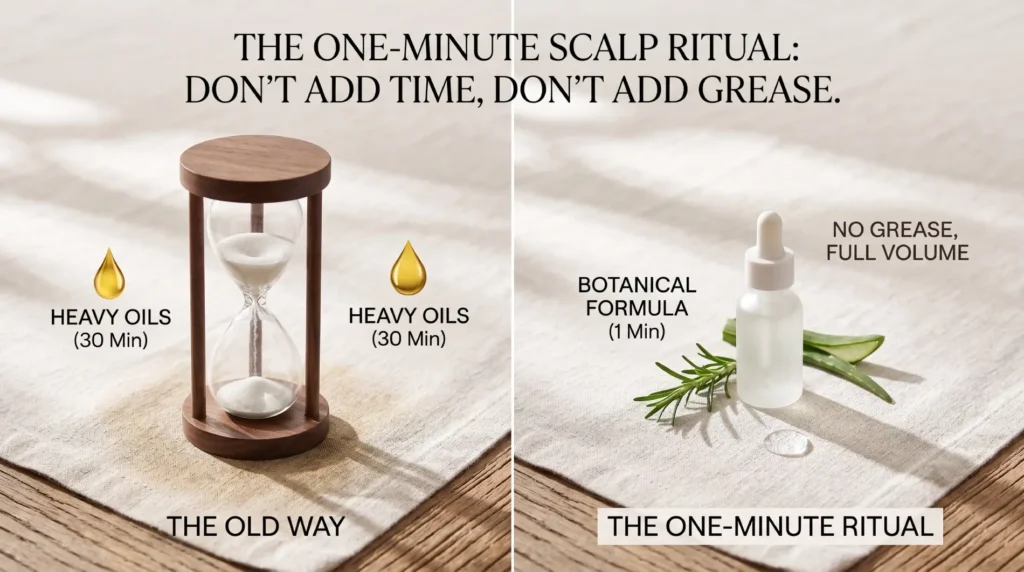
Here is the scalp ritual in full. It genuinely fits in the time it takes your coffee to brew.
Seconds 0–15: Part and target. Make a parting down the middle, then one or two more on each side. This exposes the scalp and helps place the product on the intended area instead of coating the lengths, where it may add unwanted weight or residue.
Seconds 15–35: Apply lightly. Along each parting, apply a small amount of a lightweight scalp treatment — a water-light tonic or serum, not a heavy oil. A little goes a long way. You want the scalp lightly covered, not saturated. If your hair looks wet afterwards, you’ve used too much.
Seconds 35–60: Massage gently. Using the pads of your fingers, not your nails, make small circular movements across the scalp for about twenty-five seconds. The aim is to spread the product and make the ritual feel comfortable. Avoid hard rubbing, and stop if the scalp feels sore. Claims that this brief step “boosts blood flow to the follicles” in a way that produces hair growth go beyond the evidence.
That’s it. Use it on dry or damp hair if the product label allows. A well-chosen amount may fit into a routine without a rinse or full restyle, although residue depends on the formula, hair type and how much you apply.
Why this scalp ritual works without the grease
Reducing residue comes down to three choices. First, apply along partings rather than raking product through the lengths. Second, choose a lightweight leave-in formula rather than a rich oil if you do not want a wash-out step. Third, start with the smallest amount recommended on the label. A greasy finish can come from the formula, the dose, the application area or the way a product interacts with your hair.
Make the routine easy to repeat
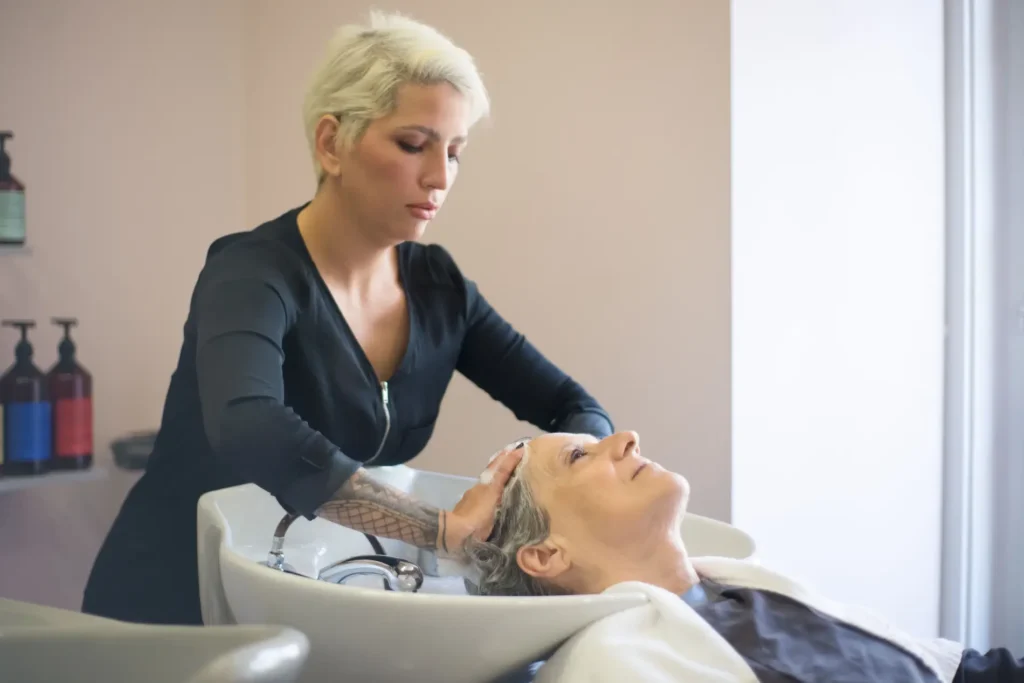
The main advantage of a one-minute ritual is behavioural: it lowers the effort required to use a cosmetic product as directed. That does not mean more frequent use is automatically better. Follow the label, begin conservatively, and reduce the frequency or stop if you develop itching, burning, redness or persistent residue.
That is why the ritual is deliberately easy. Habit helps only when the product suits your scalp and the routine has a realistic cosmetic goal.
A quick reality check on what a scalp ritual can do
Cosmetic scalp comfort and hair regrowth are different goals. A leave-in cosmetic may help the scalp feel hydrated, soothed or less tight if its ingredients suit you. Massage may feel relaxing and help spread the product. Neither outcome demonstrates that follicles are producing more hair. Hair loss can have genetic, hormonal, inflammatory, nutritional, medication-related and other causes, so persistent or concerning loss needs an appropriate diagnosis rather than a cosmetic serum.
If you are worried about hair loss, the NHS advises seeing a GP to understand the cause before approaching a commercial hair clinic. Seek medical advice sooner for sudden or patchy loss, a painful or inflamed scalp, scarring, or symptoms that persist.
Daily or weekly? Let the formula and your scalp decide
There is no universal rule that daily scalp care is better than a weekly treatment. A water-light leave-in and a rich wash-out mask serve different cosmetic purposes, and each should be used according to its label. The right schedule is the one that fits the formula, your wash routine and your scalp’s response.
What matters is avoiding extremes. More product and more massage do not guarantee a better result. If a product causes buildup or irritation, using it more often is likely to make the routine less comfortable, not more effective.
A short ritual can still be useful because it makes precise application easier and gives you a moment to notice changes in the scalp. Massage is free and can feel pleasant, but it should not be presented as a proven follicle treatment.
There is a behavioural argument too: low-friction habits are easier to repeat. A one-minute, no-rinse step may fit a busy week better than a wash-out mask. That is a convenience advantage, not evidence of superior hair growth.
Fitting the scalp ritual around your wash day
On wash days, apply after towel-drying and before styling if the product directions permit use on damp hair. Damp hair may be easier to part, and applying before styling can make the extra step easier to remember.
On non-wash days, use it on dry hair only if the label permits. Start with a small amount on the scalp rather than the lengths. If it leaves more shine or weight than you want, reduce the amount or frequency, or choose a different formula.
If you use dry shampoo, avoid layering products blindly. Check both labels; when compatible, applying a liquid scalp product first and letting it dry before dry shampoo may reduce clumping.
If you exercise, post-workout can be a convenient cue, but do not apply a leave-in over a sweaty or irritated scalp unless its directions support that use.
Choosing a product built for a one-minute scalp ritual
For a no-rinse weekday ritual, finish matters. Look for a leave-in tonic, essence or light serum if you want less weight than an oil or butter. Product type alone does not guarantee a residue-free finish, so start with a small amount.
Do not judge a formula by one ingredient’s position alone. Alcohol-containing products can feel drying or irritating to some people, while the complete formulation and dose affect how a product behaves. If your scalp is dry or sensitive, choose a product labelled for that concern, patch test as directed, and stop if irritation develops.
An applicator can make precise placement easier. A nozzle or dropper may reach the scalp through the hair more directly than dispensing into the palms, although the best format is the one you can control without overapplying.
Fragrance and essential oils can irritate or trigger allergy in some people. If your scalp is sensitive or you have reacted before, a fragrance-free option may be a sensible starting point. “Natural” does not automatically mean non-irritating.
The massage technique that makes it worth doing
Use the pads of your fingers, never your nails. Nails scratch a scalp that may already be sensitised, and broken skin is the last thing you want.
Move the scalp, do not slide over it. This is the bit almost everyone gets wrong. Plant your fingertips, press gently, and move the skin over the skull in small circles. If your fingers are travelling through your hair, you are massaging your hair, not your scalp.
Work in a simple pattern if that helps distribute the product: start at the hairline, move back along the parting, then cover only the other areas where the label directs application. There is no need to massage every part of the scalp.
Sixty seconds is enough to complete this application routine; it is not a clinically established dose for hair growth. Pressure should be gentle and comfortable. If your scalp feels tender afterwards, stop and use less pressure next time.
Troubleshooting your scalp ritual
My roots look greasy afterwards. You may be using too much, coating the lengths or using a formula that is too rich for the finish you want. Try a smaller amount if that remains within the label directions; if the result still feels heavy, choose a different format.
My scalp itches after applying. Stop using the product and rinse it off if the label permits. Do not treat itching, burning or redness as proof that it is working. If the reaction is severe, spreads, or does not settle, seek medical advice.
I keep forgetting. Attach the scalp ritual to something you already do without thinking — brushing your teeth, or the kettle boiling. Leave the bottle where you will see it, not in a drawer.
Nothing has changed after a month. First define the expected change. A cosmetic leave-in may improve feel or manageability, but it should not be expected to increase density. If you are tracking hair loss, photographs can document change, but they do not replace a diagnosis or evidence-based treatment plan.
My hair feels heavy by day two. Reduce the amount or frequency if the label allows, and make sure you are targeting the scalp rather than coating the lengths. If buildup continues, stop or choose another product.
When a scalp ritual is not the answer
If you are shedding heavily or suddenly, pause the cosmetic experiment and seek medical advice. There are many possible causes, and the useful next step is identifying the cause rather than assuming a tonic will solve it. For background, read the guide to telogen effluvium and the NHS overview of hair loss.
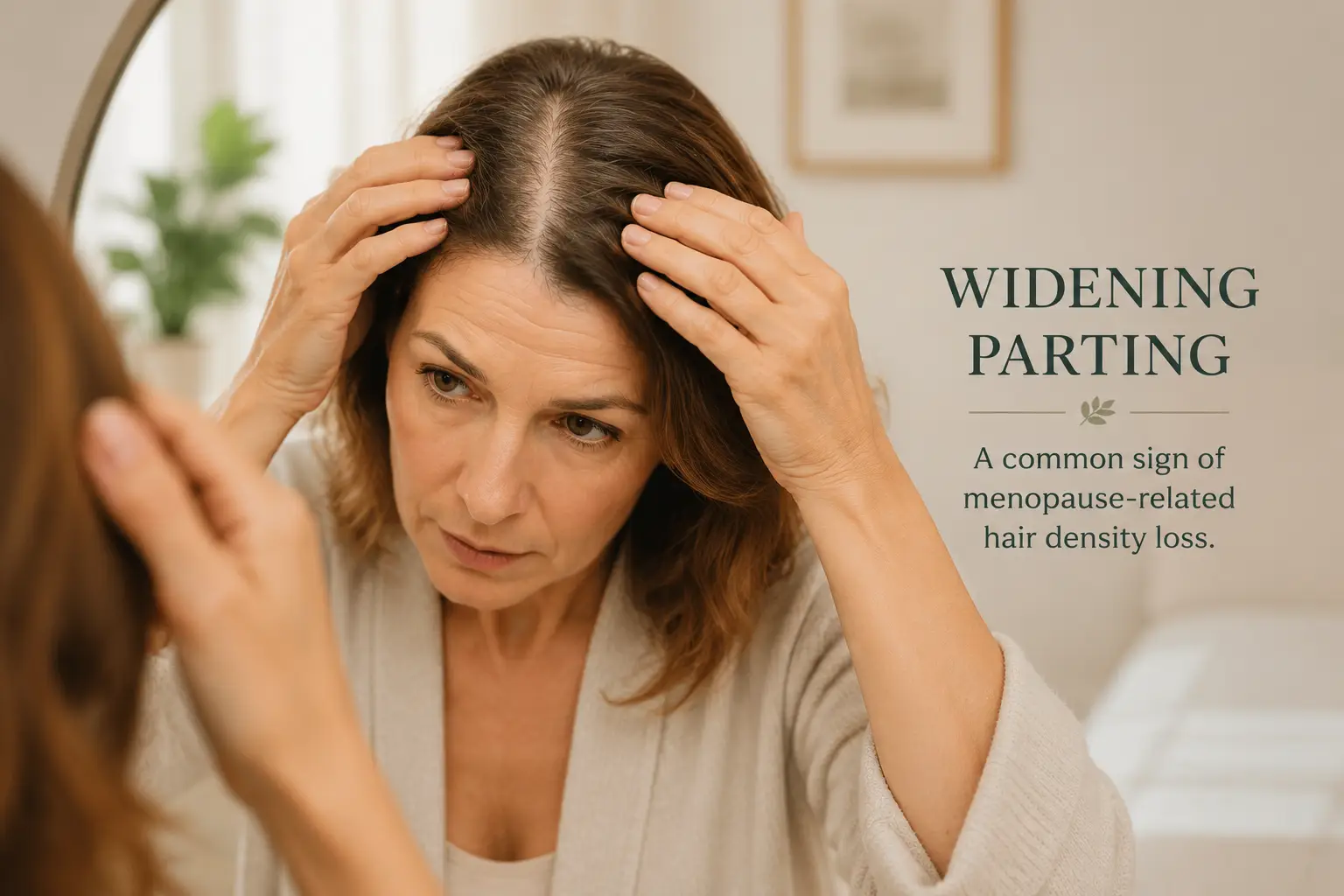
If density is falling gradually, age, family history, health, medications and hormonal changes may all be relevant. This guide to menopause and hair thinning provides background, but a clinician should assess your individual pattern and history.
If your scalp is red, scaly, sore, scarred or losing hair in defined patches, treat that as a medical question rather than a cosmetic one. See a GP or dermatologist. The American Academy of Dermatology explains why finding the cause is the first step toward effective treatment.
What to track over twelve weeks—and what not to promise
In weeks one and two, focus on practical fit: find the smallest useful amount, note whether the roots stay presentable, and watch for irritation. Do not push through burning, persistent itch or tenderness for the sake of consistency.
In weeks three to six, assess the cosmetic outcomes the product actually claims. Does the scalp feel comfortable? Is there less unwanted residue? Is styling easier? Improvement is not guaranteed, and new or worsening itch, scale or redness is a reason to stop and reassess.
In weeks seven to twelve, continue only if the ritual remains comfortable and useful. Do not reinterpret normal variation in photographs as proof of regrowth. Lighting, part placement, styling and wash timing can all change how density looks.
At twelve weeks, the honest success measures are comfort, finish, manageability and whether the routine is worth the time and cost. A cosmetic ritual is not a validated regrowth programme. For context, a small study of nine men without obvious hair loss tested four minutes of device-assisted massage daily for 24 weeks and reported increased hair thickness but no significant change in hair growth rate; it does not establish that a 60-second fingertip ritual regrows hair. Read the published study.
One last thing worth saying: keep it comfortable and easy. A cosmetic ritual is optional; it should not become another obligation or something you continue despite irritation.
A disclosed cosmetic option
Disclosure: Nunu Moor Scalp & Hair Tonic is our own cosmetic product in development. It is designed for everyday scalp care, heat protection and light styling—not for diagnosing, treating or reversing hair loss. Check the finished product directions and ingredient list when available, especially if your scalp is sensitive.
If a quick cosmetic routine suits your needs, you can join the Nunu Moor launch waitlist for early access and founder pricing. This is a commercial call to action, not a medical recommendation or a promise of hair growth.
A scalp ritual does not have to be a project. Keep the application light, be gentle, and judge it by realistic outcomes such as comfort, finish and ease of styling—not by unsupported regrowth promises.
FAQ:
How long should a scalp treatment take? A cosmetic application can take about one minute if the product is designed to remain on the scalp. Follow its directions; one minute is a convenience target, not a proven hair-growth protocol.
Will a scalp treatment make my hair greasy? It can. To reduce the chance of residue, choose a lightweight leave-in formula, apply it to the scalp along partings rather than through the lengths, and start with the smallest amount allowed by the directions.
How often should I do a scalp routine? Follow the product label and adjust for your scalp’s response. Daily use is not automatically better than weekly use, and irritation is a reason to stop rather than persist.
Can I do scalp care on dry hair? Yes, if the product is intended for dry-hair application. Some formulas can be used on dry or damp hair; follow the individual label.
Does scalp massage actually help? It can feel relaxing and help distribute a cosmetic product. Evidence for hair regrowth is limited, and no good evidence establishes a 60-second massage as a treatment for thinning. Do not substitute it for medical assessment or an evidence-based hair-loss plan.
Related reading on building a scalp ritual
- Greasy scalp after washing? Why your serum may be the cause
- Seaweed for scalp health: the minerals your hair needs
- Ginkgo biloba for hair: does scalp circulation help?
Sources and further reading: NHS — Hair loss; American Academy of Dermatology — Hair loss: diagnosis and treatment; Koyama et al. (2016) — standardized scalp massage study. This article is general information, not medical advice.