QUICK ANSWER
Ginkgo biloba is used in some scalp products because it has vascular and antioxidant effects in laboratory research. However, no convincing human trial shows that topical or oral ginkgo treats scalp hair loss. Mouse studies are interesting but preliminary, so ginkgo is best viewed as an optional cosmetic ingredient—not a way to “wake” dormant follicles or replace evidence-based care.
KEY TAKEAWAYS
- Healthy follicles have a close relationship with surrounding blood vessels, but “more scalp circulation” does not automatically mean more human hair growth.
- Ginkgo has produced hair-growth signals in mice; clinical evidence for human scalp hair is lacking.
- Rosemary oil has one small human comparative trial, but that does not prove it works through circulation or equals standard minoxidil treatment in every setting.
- Oral ginkgo can interact with medicines and may increase bleeding risk, so it should not be taken for hair without advice from a pharmacist or clinician.
- Sudden, patchy or heavy shedding needs assessment rather than a botanical experiment.

Ginkgo biloba for hair often appears beside the promise to “wake up dormant follicles.” That phrase is marketing, not a clinical description. Follicles can miniaturise, move through growth and rest phases, become inflamed or be destroyed by scarring disease; a botanical has not been shown to switch all of those processes back on. Here is what the evidence actually supports—and where it stops.
What microcirculation actually means for hair
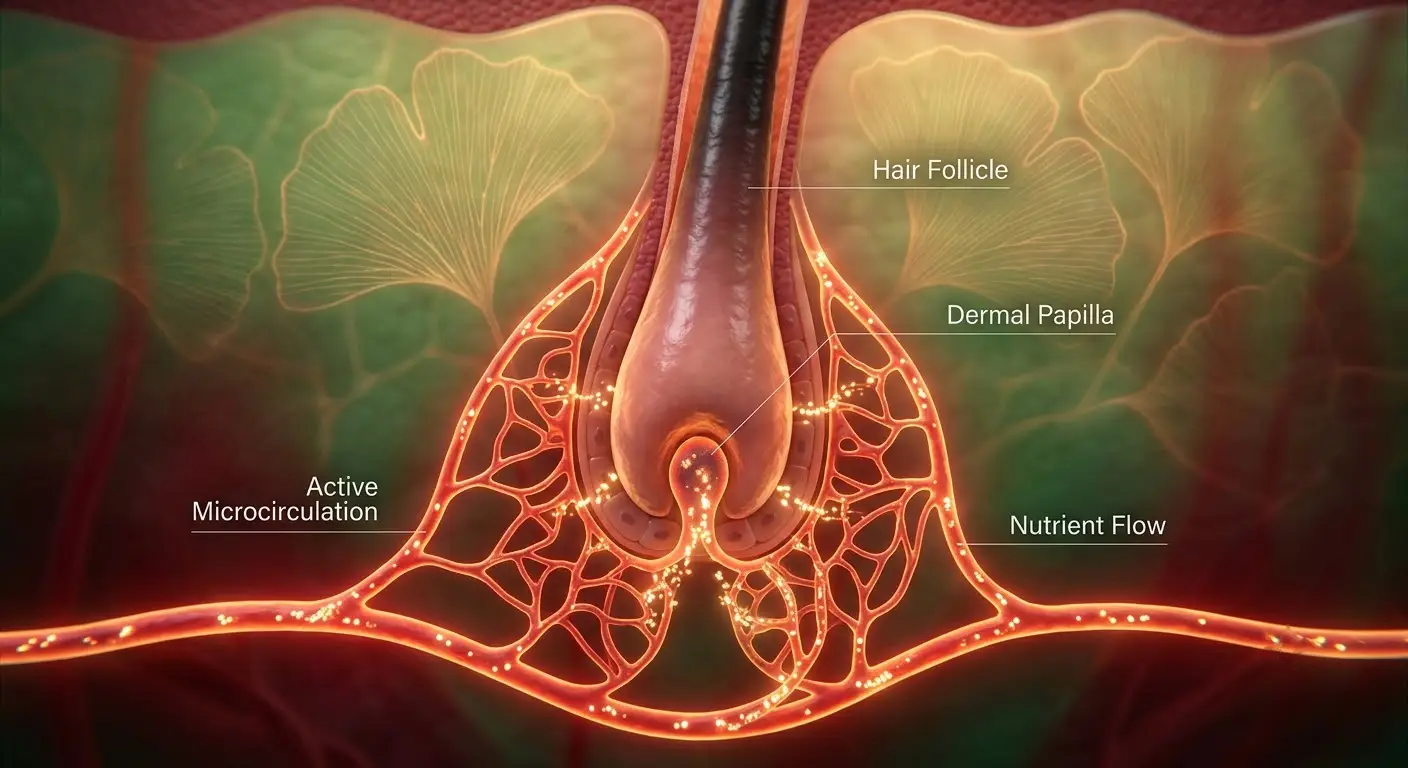
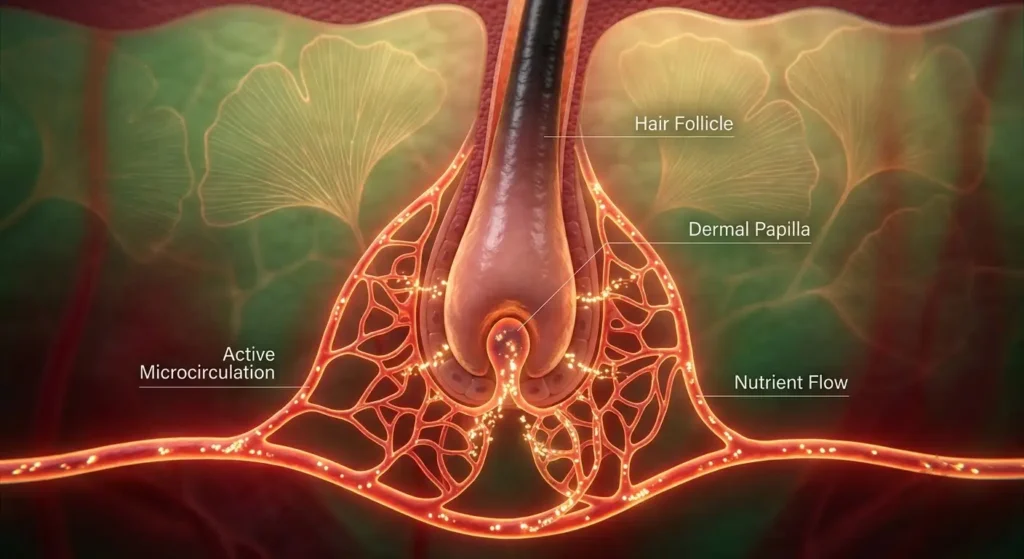
Hair follicles are supplied by vessels in the surrounding tissue. In mouse models, blood-vessel remodelling changes across the hair cycle, and experimental manipulation of VEGF-mediated angiogenesis altered follicle size and regrowth after depilation. That makes vascular support biologically relevant, but it does not establish that a circulation-boosting cosmetic will regrow human scalp hair. The relationship is more complicated than “more blood flow equals more hair.” Read the primary VEGF and hair-follicle study.
This distinction matters. Androgenetic hair loss involves genetically influenced androgen signalling and progressive follicle miniaturisation; alopecia areata is immune-mediated; telogen effluvium can follow illness, nutritional problems, medication changes or major stress. Improving how warm or flushed the scalp feels does not correct those causes.
Where ginkgo biloba for hair fits—honestly
Ginkgo leaf extracts contain multiple biologically active compounds and have been studied in vascular, inflammatory and antioxidant contexts. That broader pharmacology is probably why the ingredient migrated into scalp formulas. It is still a leap, however, from effects in cells or other tissues to meaningful hair regrowth in people.
The direct hair evidence is preclinical. A 1993 study in C3H mice reported faster regrowth of shaved hair with a ginkgo leaf extract. A newer study of purified ginkgo polysaccharides reported hair-growth and inflammatory-marker changes in a mouse model of alopecia areata and effects in cultured cells. Neither study demonstrates that a retail ginkgo serum—or an oral supplement—regrows hair in humans.
No well-designed human clinical trial has established an effective topical concentration, dose, formulation or treatment period for ginkgo and scalp hair loss. The fairest summary is therefore: a plausible research lead with animal data, but no proven human benefit.
Rosemary versus ginkgo biloba for hair
Rosemary oil has more human evidence than ginkgo, but the gap should not be overstated. In one 2015 randomised comparative trial, 100 men with androgenetic alopecia were assigned rosemary oil or 2% minoxidil for six months. Both groups had higher hair counts at six months than at baseline, and the study found no statistically significant difference between groups. It did not include a placebo group, tested 2% rather than 5% minoxidil, and has not by itself settled rosemary’s efficacy.
The trial also does not prove that rosemary worked by increasing circulation. Rosemary should be described as a botanical with limited clinical evidence, not as a natural equivalent to minoxidil. Essential oils can irritate or sensitise the scalp, so use a properly formulated product, follow its directions and patch test rather than applying undiluted essential oil.
How to use scalp botanicals sensibly
- Choose a finished cosmetic. Home-mixing makes concentration, stability and preservation hard to control. Do not apply neat essential oils.
- Patch test first. Apply a small amount as the manufacturer directs and stop if you develop persistent burning, itching, swelling or a rash.
- Treat massage as optional, not curative. A tiny study of nine healthy men found increased hair thickness after standardised device massage, but no increase in growth rate and no proof that massage treats hair loss. See the scalp-massage study.
- Change one thing at a time. Starting several products together makes benefit or irritation difficult to attribute.
- Set a stop point. If photographs taken in the same light and parting show no worthwhile change after a reasonable trial, do not keep spending because of a vague promise.

When circulation is not the whole story
Botanicals can be part of a cosmetic scalp routine, but they do not diagnose or treat an underlying disease. Seek medical advice for sudden, patchy or heavy shedding; scalp pain, marked redness or scarring; or hair loss accompanied by other symptoms. A clinician can decide whether examination or tests for causes such as iron deficiency or thyroid disease are appropriate. The NHS hair-loss guide explains common causes and when to see a GP.
Minoxidil is an evidence-based option for some types of pattern hair loss, but it is not suitable for everyone and benefits are maintained only with continued use. A pharmacist, GP or dermatologist can help match treatment to the diagnosis instead of assuming every case is “poor circulation.”
What the research actually says about ginkgo biloba for hair
Evidence has a hierarchy. Cell studies can identify mechanisms. Mouse studies can test a biological idea in a living system. Human randomised trials can begin to show whether a defined product provides a meaningful benefit and what harms occur. Ginkgo has not reached that final stage for scalp hair.
The older mouse study used an ethanolic leaf extract in shaved C3H mice. The newer study used isolated water-soluble polysaccharide fractions in mice with experimentally modelled alopecia areata and in cultured cells. Those materials and disease models are not interchangeable with one another—or with a consumer serum. Marketing that cites “ginkgo research” without naming the extract, model and route hides these important differences.
A shaved mouse coat regrowing faster is also not the same as reversing years of follicle miniaturisation on a human scalp. These studies justify further research; they do not justify a treatment claim.
Ginkgo biloba for hair: topical or oral?
Topical products usually contain a ginkgo leaf extract in a cosmetic base, but labels rarely reveal enough about extraction method or standardisation to compare one formula with the material used in research. There is no established topical dose for hair growth.
Oral ginkgo creates systemic exposure without established hair benefit. The US National Center for Complementary and Integrative Health says there is no conclusive evidence that ginkgo helps any health condition and warns that it may interact with medicines and increase bleeding risk with anticoagulants. Taking it for hair is therefore not supported by the evidence. Read the NCCIH ginkgo safety summary.
Who should be cautious with ginkgo biloba
Check with a pharmacist or clinician before starting oral ginkgo if you take medicines—especially anticoagulant or antiplatelet drugs—or if you have a bleeding disorder or an operation planned. Tell your surgical team about all supplements rather than choosing a stopping date yourself.
Ginkgo may be unsafe in pregnancy, and little is known about safety while breastfeeding. Fresh ginkgo seeds are toxic; serious adverse effects have also occurred after roasted seeds or crude plant material. These warnings concern ingestion and should not be blurred with a properly formulated topical cosmetic, but topical products can still cause irritation or allergic contact dermatitis.
For a topical product, patch test and follow the label. Avoid applying it to broken or inflamed skin, and stop if irritation persists. “Natural” does not mean inactive or allergy-proof.
How to tell whether a cosmetic is doing anything
First decide what outcome you are measuring. Less itch, easier styling or a less greasy feel are cosmetic outcomes and may appear relatively quickly. Hair density, shaft diameter and shedding are different outcomes and need consistent measurement over months.
Take monthly photographs in the same location, lighting, angle and parting. Keep the rest of the routine stable where practical, and record irritation as well as perceived benefit. Photographs cannot diagnose hair loss, but they are more useful than memory alone.
Do not interpret normal day-to-day shedding variation as proof of regrowth. If the aim is to treat a diagnosed hair-loss condition, use a treatment plan with evidence for that condition rather than relying on a cosmetic ginkgo product.
Ginkgo biloba for hair versus alternatives
Rosemary has one small human comparative trial; ginkgo has mouse and cell research; peppermint oil’s frequently repeated hair-growth claim comes mainly from a mouse study; and topical caffeine has laboratory research plus limited, mixed-quality clinical evidence. None has the depth of evidence behind established medical options for pattern hair loss.
That does not make a botanical cosmetic pointless. A gentle formula may improve how the scalp feels or make a routine easier to maintain. The honest boundary is that comfort and conditioning are not the same as treating alopecia.
What ginkgo biloba for hair cannot be claimed to do
- It has not been shown to reverse androgen-driven follicle miniaturisation.
- It cannot correct iron deficiency, thyroid disease or another systemic cause of shedding.
- It cannot restore follicles destroyed by scarring alopecia.
- It has not been proved to “wake” dormant human follicles.
How to read a label that features ginkgo biloba
Look for Ginkgo Biloba Leaf Extract in the ingredient list, but do not assume its position reveals an exact percentage. UK guidance requires ingredients at 1% or more to be listed in descending order; ingredients below 1% may appear in any order after them. Position can provide context, not a reliable dose. See the UK cosmetic-labelling guidance.
Pay equal attention to the whole formula. Fragrance, essential oils, high-alcohol formulas and numerous plant extracts can be problematic for a reactive scalp, while the vehicle determines whether a product feels oily, sticky or comfortable. A long botanical list is not evidence of efficacy.
Be sceptical of percentages and user-satisfaction claims without a clear method. Ask how many people were studied, whether there was a comparison group, what outcome was measured, how long the study ran and whether the tested formula is the product being sold.
A disclosed cosmetic option
Disclosure: Nunu Moor Scalp & Hair Tonic is our own commercial cosmetic product in development. It is intended for everyday scalp and hair care, heat protection and light styling—not to treat hair loss, “wake” follicles or replace medical care.
If that cosmetic scope suits your needs, you can join the Nunu Moor launch waitlist for early access and founder pricing. This call to action is commercial; the ginkgo studies discussed above do not establish efficacy for the finished tonic.
FAQ:
Does ginkgo biloba help hair growth?
Mouse studies report hair-growth effects, but there is no convincing human clinical evidence that ginkgo grows scalp hair or treats hair loss.
Does scalp circulation affect hair?
Follicles interact closely with surrounding vessels, and animal research shows vascular remodelling is involved in the hair cycle. That does not mean simply increasing scalp blood flow will reverse human hair loss.
Is rosemary oil better than ginkgo biloba for hair?
Rosemary has one six-month human comparative trial, while ginkgo’s direct evidence is preclinical. Rosemary is therefore better studied, but it is not proven equivalent to standard minoxidil treatment, and the trial did not establish circulation as its mechanism.
Can ginkgo biloba wake dormant follicles?
That claim has not been demonstrated in humans. Miniaturised follicles, resting follicles and follicles destroyed by scarring are different biological situations and cannot be grouped under the marketing word “dormant.”
How should I use rosemary oil safely?
Use a properly formulated product according to its instructions, patch test first and do not apply undiluted essential oil. Stop if you develop persistent irritation.
Is oral ginkgo worth trying for hair?
No human evidence establishes a hair benefit, while oral ginkgo has real interaction and bleeding cautions. Discuss it with a pharmacist or clinician rather than taking it for hair based on a cosmetic claim.
Related reading on scalp care and botanicals
- Seaweed for scalp health: what minerals can and cannot do
- The one-minute scalp ritual: a simple cosmetic routine
- Menopause hair thinning and scalp changes
Sources and further reading
- Kobayashi et al. (1993): ginkgo leaf extract and hair regrowth in C3H mice
- Li et al. (2022): ginkgo polysaccharides in a mouse alopecia areata model and cultured cells
- Yano et al. (2001): VEGF-mediated angiogenesis and hair follicles in mice
- Panahi et al. (2015): rosemary oil versus 2% minoxidil
- NCCIH: Ginkgo—usefulness and safety
This article provides general information, not medical advice. Speak to a pharmacist or clinician before taking oral ginkgo, particularly if you use medicines or have surgery planned.