Quick Answer
Perimenopause hair changes happen because declining oestrogen shortens the hair’s growth phase and lets androgens like DHT gradually thin each follicle. The result is fewer, finer strands and drier, coarser texture — often starting in the mid-40s. It’s normal and manageable, though sudden or heavy shedding warrants a GP check.
Key Takeaways
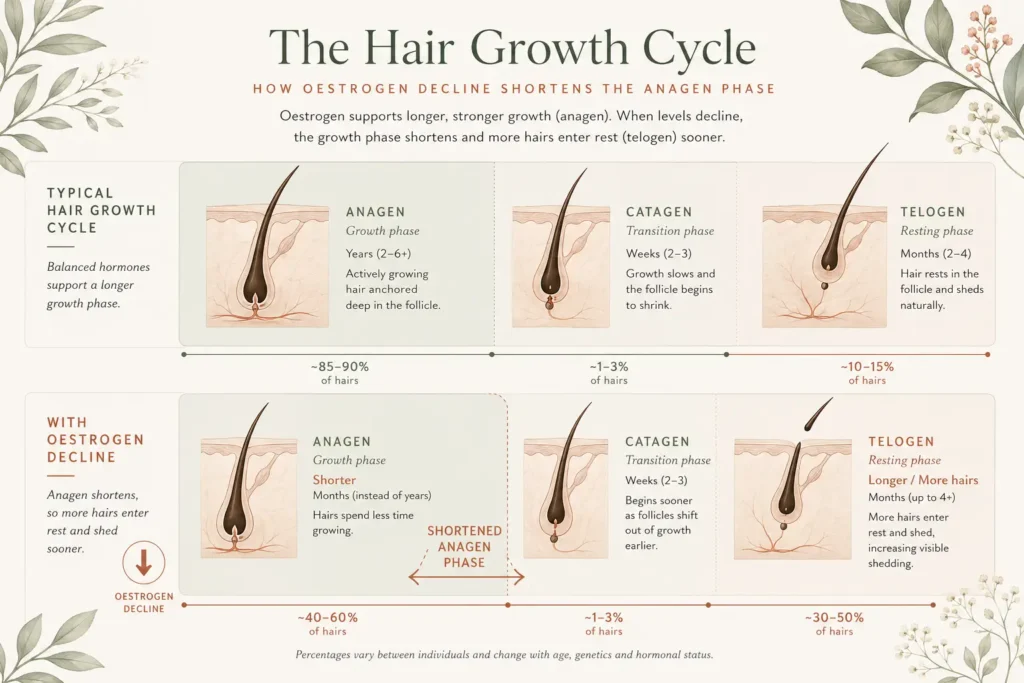
- Oestrogen decline shortens the hair growth (anagen) phase, so you shed sooner and grow back finer.
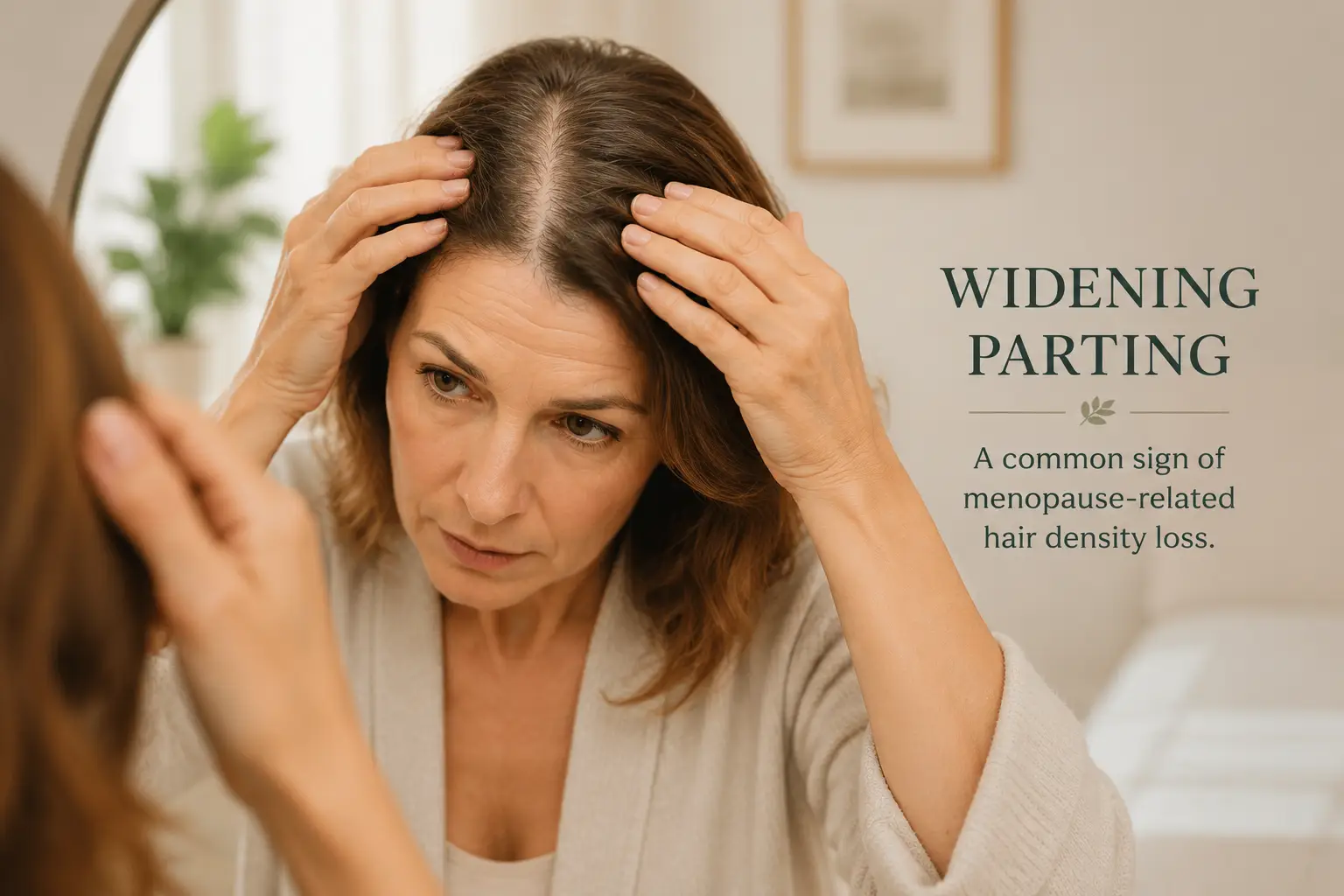
- You lose hairs and the remaining hairs miniaturise — thinning shows as a widening parting, not a bald patch.
- Perimenopause commonly begins mid-40s; UK average menopause age is ~51.
- Iron, ferritin, thyroid and vitamin D can cause identical thinning — get bloods before assuming it’s “just menopause.”
You reach back to tie your hair up and the ponytail feels thinner than it used to. The parting looks a little wider in photos. Strands that were once smooth now feel coarse, dry, almost wiry at the crown — and no amount of the conditioner you’ve always trusted seems to fix it. If you’re somewhere around 45 and quietly wondering whether you’re imagining all this, let me put your mind at rest straight away: you’re not.
Perimenopause hair changes are one of the most common things women tell me about at this stage of life, and one of the least talked about. Everyone warns you about hot flushes and disrupted sleep. Almost nobody mentions that your hair can start behaving like it belongs to a different person.
Here’s what’s actually going on, why it happens, and — just as importantly — what’s worth doing about it.
It starts with a quiet drop in oestrogen
Perimenopause is the run-up to menopause, and it can begin earlier than most women expect — often in the mid-40s, sometimes sooner. In the UK the average age of menopause itself is around 51, but the hormonal shifts leading up to it can unfold across a decade. So if your periods are still arriving, more or less, but your hair has changed, the timing isn’t a coincidence.
The hormone doing most of the talking here is oestrogen. Among its many jobs, oestrogen helps keep your hair in its active growing phase for longer. Each hair on your head moves through a cycle: a long growth phase (anagen), a brief transition, and a resting phase before it sheds and a new hair takes its place. Healthy, plentiful oestrogen tends to lengthen that growth phase — which is part of why so many women notice their hair looked its thickest during pregnancy, when oestrogen was high.
As oestrogen declines in perimenopause, that growth phase shortens. Hairs spend less time growing and reach the shedding stage sooner. The result is more hair in the brush, a smaller ponytail, and a general sense that things are thinning even if you can’t point to a bald patch.
Why the hairs get finer, not just fewer
This is the part that surprises people. Menopausal hair change isn’t only about losing hairs — it’s about the hairs themselves getting thinner.
As oestrogen falls, the small amount of androgens (so-called “male” hormones that all women have) has a relatively louder voice. In women who are genetically sensitive to it, one androgen in particular — dihydrotestosterone, or DHT — can gradually shrink the hair follicle over successive cycles. Each new hair the follicle produces comes through a little finer and a little shorter than the last. Over years, this is what dermatologists call follicle miniaturisation, and it’s the mechanism behind female-pattern thinning, usually seen as widening across the crown and parting rather than a receding hairline.
So when your hair feels different, you’re often experiencing two things at once: fewer strands, and finer strands. That combination is why the change can feel surprisingly sudden even though the biology is gradual.
The texture shift: dry, coarse, unruly
There’s a third piece, and it’s the one that drives people slightly mad day to day. Your scalp’s oil glands are influenced by hormones too. As the hormonal balance shifts, many women find their scalp produces less of the natural sebum that used to coat and soften each strand. Less sebum travelling down the hair shaft means drier, rougher-feeling lengths — and, confusingly, some women get the opposite, an oilier scalp, as oil production rebalances unpredictably.
On top of that, greys arrive. Grey hair isn’t just a colour change; the strand itself is often coarser, drier and more wiry, which adds to that “my hair won’t behave” feeling. (I’ve written a whole separate guide on managing grey texture without weighing it down — link below.)
Before you blame hormones for everything
Here’s where I want to be honest with you, because a good hair expert should be. Perimenopause is a very common reason for hair change at this age — but it isn’t the only one, and the symptoms overlap almost exactly with several other causes.
Low iron and low ferritin (your iron stores) are extremely common in women and a frequent, very treatable cause of thinning. Thyroid changes become more likely with age and cause near-identical shedding. Low vitamin D, sudden stress, crash dieting and certain medications can all do the same.
None of these can be diagnosed by a blog. So if your shedding is heavy, sudden, or getting worse, please book a GP appointment and ask for blood tests — a full blood count, ferritin, thyroid function and vitamin D are all reasonable to request. Ruling these in or out early gives you far more options. Reassurance is worth a lot; so is catching something simple and fixable.
What genuinely helps at the scalp
Once the medical bases are covered, the everyday question is: what can I actually do?
The honest answer is that hormonal change itself can’t be reversed with a bottle, and I’d be wary of anyone promising otherwise. What you can do is give your scalp — the soil your hair grows from — the healthiest possible environment. That’s where real, unglamorous progress lives.
A few principles I’d stand behind:
- Treat the scalp as skin. It has pores, oil glands and a microbiome, and it responds to care. A clean, calm, well-circulated scalp is simply a better place to grow hair from.
- Be gentle with fragile hair. Finer, drier midlife hair snaps more easily. Loosen tight styles, swap harsh brushing for a wide-tooth comb on wet hair, and go easier on high heat.
- Support circulation. A minute or two of daily scalp massage feels good, lowers tension, and encourages blood flow to the follicles — free, and quietly worthwhile.
- Feed it, don’t strip it. Look for lightweight, botanically-driven scalp care that nourishes rather than coats. Heavy silicone products can give a short-lived gloss while building up over time.
This last point is exactly the space we’ve been working in. Kartee’s Hair Tonic — a botanical, scalp-first formula designed with women over 40 in mind — is still in development, and I’d rather get it right than rush it out. If you’d like to be first to know when it’s ready (and to get the science-led guidance we’re sharing along the way), you can join the waitlist over at kartee.salon.
For now, know this much: the change you’re noticing is real, it’s normal, and it’s far more manageable than it feels at 8am with a hairbrush full of evidence. Understanding why it’s happening is the first, most steadying step — and you’ve just taken it.
FAQ
- At what age do perimenopause hair changes start? Often in the mid-40s, sometimes earlier. The average UK menopause age is around 51, but hormonal shifts can begin up to a decade before periods stop.
- Why is my hair getting finer, not just falling out? As oestrogen drops, androgens like DHT have more relative influence and can shrink sensitive follicles, so each new hair grows through finer and shorter.
- Will menopausal hair thinning grow back? Hormonal thinning is gradual and can’t be fully reversed by a product, but supporting scalp health and treating any deficiencies helps you keep and strengthen the hair you have.
- Is menopause the only cause of thinning at 45? No. Low iron/ferritin, thyroid changes and low vitamin D cause near-identical thinning and are treatable — a GP blood panel is worth doing first.
- Can scalp care help menopausal hair? It can’t change your hormones, but a calm, nourished, well-circulated scalp is a healthier foundation for whatever hair you’re growing.