QUICK ANSWER
Ginkgo biloba is thought to support hair by improving microcirculation — the blood flow that carries oxygen and nutrients to the follicle. The evidence is mostly preclinical, not proven human trials, so it’s best seen as a circulation-support ingredient rather than a hair-loss cure. Rosemary oil has stronger human data for the same circulation route.
KEY TAKEAWAYS
- Ginkgo’s plausible role is boosting scalp blood flow, not blocking hormones.
- Evidence is mainly lab and animal studies; large human trials are lacking.
- Good follicle “food delivery” depends on good circulation — the real logic here.
- Rosemary oil targets the same route and has a stronger human trial behind it.
- Circulation support complements, but doesn’t replace, medical treatment where needed.

There’s a phrase you’ll see everywhere in natural hair care: “wake up dormant follicles.” It sounds wonderful — the idea that your quiet, under-performing follicles are just asleep, waiting for the right ingredient to nudge them back to life. Ginkgo biloba is one of the botanicals most often credited with doing the nudging. So let me tell you what ginkgo can plausibly do, what it can’t, and how to think about it without falling for the hype.
What “microcirculation” actually means for hair
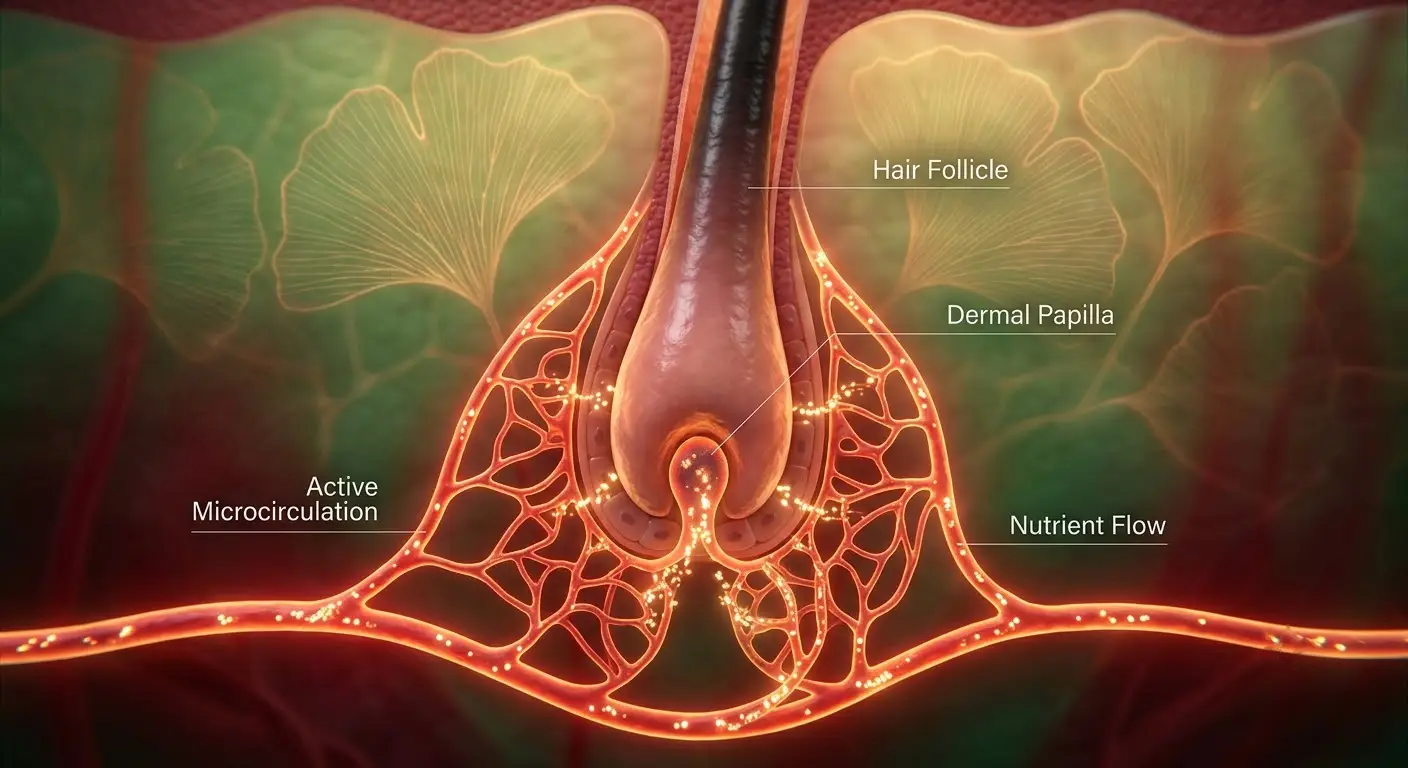
Start with the follicle itself. Every hair on your head grows from a follicle that’s fed by a tiny network of blood vessels. That blood delivers the oxygen and nutrients the follicle needs to build a strong strand, and carries waste away. When that microcirculation — the blood flow through the smallest vessels — is sluggish, the follicle is, in effect, working on a poor food delivery.
It’s an appealingly simple picture, and it holds up reasonably well: healthy follicle activity does depend on decent blood supply, and impaired blood vessel development around the follicle has been linked to hair loss in research. So an ingredient that genuinely improves scalp circulation has a logical reason to support hair health. The key word is support — feeding the follicle better is not the same as reversing hormonal hair loss.
Where ginkgo fits — honestly
Ginkgo biloba has a long history in herbal medicine, and most of its reputation rests on effects related to circulation and oxygen delivery. That’s exactly why it turns up in scalp products: the theory is that better blood flow to the scalp means better-nourished follicles.
Here’s the honest state of the evidence. Laboratory and animal studies have produced some promising signals — for example, animal research has shown improved hair growth rates with ginkgo extract. But large, well-designed human trials specifically on scalp hair are lacking, and its long-term safety and efficacy for hair loss haven’t been robustly established in peer-reviewed clinical work. In plain terms: plausible mechanism, encouraging early science, not proven in humans.
That matters for what you should expect. If your thinning is driven by hormones — as most menopausal thinning is, via DHT and follicle miniaturisation — ginkgo isn’t going to touch that hormonal cause. Its job, if it does one, is upstream: keeping the follicle well supplied. Think companion, not cure.
The stronger circulation player: rosemary
If circulation is the mechanism you’re interested in, it would be odd not to mention rosemary — because it targets the same route with better human data behind it. A 2024 randomised controlled trial found topical rosemary oil, at a 10% dilution, performed comparably to minoxidil for androgenetic alopecia, with fewer reported side effects. That’s a genuinely notable result, and it’s why rosemary has earned a place in serious scalp formulations rather than just folklore.
Two caveats keep it honest: rosemary oil can irritate sensitive skin if used undiluted (it should always be diluted), and one strong trial isn’t the same as decades of settled evidence. But as a naturally-derived, circulation-focused option, rosemary is one of the better-supported botanicals out there.
How to use circulation-support botanicals sensibly
If you want to give the circulation route a fair go, a few practical pointers:
- Pair ingredient with action. The single best circulation booster is free: a minute or two of daily scalp massage. Applying a ginkgo- or rosemary-containing product while you massage gives you both the mechanical blood-flow benefit and the botanical, at once.
- Dilute essential oils. Never apply neat rosemary (or other essential oils) to the scalp. Use a properly formulated product or a carrier oil.
- Patch test first. Botanicals aren’t automatically gentle. Test on a small area, especially if your scalp is sensitive or reactive.
- Give it time, and be realistic. Hair works on a slow cycle — months, not days. And manage expectations: circulation support helps the follicle do its job; it doesn’t override a hormonal or medical cause.
When circulation isn’t the whole story
I’ll say this in every ingredient post, because it’s true: botanicals support a healthy scalp, but they don’t diagnose or treat medical hair loss. If your shedding is sudden, heavy or patchy, or if you’ve ruled nothing out, see your GP and ask about iron, ferritin, thyroid and vitamin D. Minoxidil remains the only UK-licensed treatment specifically for female-pattern hair loss, and for some women that’s the right conversation to have alongside a good scalp routine, not instead of one.
The scalp-first philosophy behind Kartee
This is the thinking we’re building into Kartee’s Hair Tonic: a botanical, scalp-first formula designed to support the scalp environment — including the circulation that feeds your follicles — rather than to make claims it can’t keep. It’s still in development, and we’d rather formulate it properly than rush it.
If a science-led, no-hype approach to botanicals is what you’ve been looking for, join the waitlist at kartee.salon. You’ll be first to know when the Tonic is ready, and you’ll keep getting honest breakdowns like this one in the meantime.
Dormant follicles waking up makes a lovely headline. The grounded version — feed the follicle well, support its blood supply, be patient, and treat the real cause where there is one — is less magical but far more likely to actually help.
FAQ
Does ginkgo biloba help hair growth? It may support hair by improving scalp circulation, but the evidence is mostly preclinical. It’s best viewed as a circulation-support ingredient, not a proven hair-loss treatment.
How does scalp circulation affect hair? Blood flow delivers oxygen and nutrients to the follicle. Better microcirculation means the follicle is better supplied to build healthy hair.
Is rosemary oil better than ginkgo for hair? Rosemary has stronger human evidence — a 2024 trial found it comparable to minoxidil for pattern hair loss — though both work via circulation rather than hormones.
Can you really “wake up” dormant follicles? You can support follicle health with better circulation and scalp care, but truly miniaturised or hormonally affected follicles won’t simply switch back on from a botanical alone.
How do I use rosemary oil on my scalp safely? Always dilute it (around 10% or in a formulated product), patch test first, and never apply essential oils neat.